
Show Me the Money: Top Tips on Securing Funding for ‘Green’ Capital Projects
The screen sector faces a challenging funding landscape when it comes to capital projects. Keeping up-to-speed with the different sources and types of funding takes time and effort. Each funding application brings with it different hoops to jump through, with no guarantee of success. In addition, competition for funding is increasing.
We face increasing energy costs and insecurity, in a world where war, conflict and injustice are fuelled by our dependence on fossil fuels. At the same time, the consequences of the damage we are doing to our planet are increasingly felt. We need now, more than ever, to do what we can to future-proof our buildings.
These are our top tips, to increase your chances of securing funding for ‘green’ capital projects, projects which can help to future-proof your buildings, and your business.

1.
Build a clear WHY into your fundraising. Be clear about what you want to achieve and why, and make a clear case for the range of benefits your project can bring for the planet, for people and for your business.
2.
Be ready to go WHEN funding opportunities arise. Identify and track potential funding sources and make sure you have the information you need when funding opportunities do arise.
3.
Be clear on WHAT options will provide the best outcomes depending on your ‘why’. Think ‘beyond carbon’ and choose your options wisely.
4.
Be resourceful, creative and collaborative in HOW you develop your capital projects. Think about how you can do things differently or even find new ways of doing things and connect with others who may be able to help.
5.
Be clear on WHO needs to be consulted, involved, trained, and informed, at what stage and how. Consult with those who will be impacted by the changes you want to make and create a shared understanding of what you are trying to achieve.


1. Build a clear WHY into your fundraising
Be clear about what you want to achieve and why. Don’t focus only on carbon and cost savings. Paint a clear picture of the range of benefits your project can bring, for the planet, for people and for your business, if it gets funded e.g.
- Energy projects: reduced emissions, reduced running costs, greater energy independence, a more comfortable environment for building users, supporting local businesses, new skills and training for staff, contribution to local authority climate action plans.
- Green walls, roofs, gardens or wildflower planting: supporting pollination, cleaner air, a cooler building, better flood resilience, a space for health and well-being.
Think beyond the ‘usual suspects’ and you might find money in places you’d never thought to look e.g. BIFFA awards for nature recovery, community buildings and cultural facilities, or grants or sponsorship from funders or businesses with strong environmental commitment.
To meet its aims of tackling rising energy costs and finding greener ways of generating power, Creative Folkestone set out to raise funding for solar panels. It secured 50% of funding needed for a £50,000 investment from the Council’s Green Business Grant Scheme. The solar panels now meet about a third of their energy needs and reduced energy bills by about £17,000 a year.
Exeter Phoenix’s investment in energy efficiency, renewable energy and a living wall enhanced the appearance, feel and experience of the building – an unexpected bonus!
Village Underground’s green roof makes its building more energy efficient through improved insulation, supports biodiversity, helps to combat the urban heat island effect and absorbs air pollution. It also dampens noise from concerts at the venue and is a place of well-being for building users.
Be credible too. Don’t overstate your environmental aims, if your main motivation is really to save money or manage costs and, in particular if you can’t yet evidence wider and longer-term environmental commitment.
Make sure you know what you can and can’t do from the start. For organisations who lease or rent their buildings, there will be some limitations to what changes can be made. For guidance on negotiating with leaseholders and landlords see Film Hub North’s DIY Retrofit Guide.
Be clear on who you are and aren’t prepared to accept funding from. How do funders’ ethical and environmental credentials align with your values and why you are seeking funding? Where are your red lines e.g. companies tied to certain industries (e.g. fossil fuels, gambling, military investment)?
2. Be ready to go WHEN funding opportunities arise


Identify and keep track of potential funding sources, opportunities and models:
- government, devolved administration and regional or local authority grants
- philanthropic foundations and trusts
- commercial or public loans, some of which are interest-free or low interest
- sponsorship e.g. from businesses ‘for good’ which prioritise positive social or environmental impact alongside profit
- crowd-funding
Check out:
- the Funding Directory developed by JB with the BFI’s Film Audience Network (FAN)
- the Funder Commitment on Climate Change – a directory of trusts and foundations committed to play their part in addressing climate change
- FAN’s Green Hour on Retrofit fundraising for community cinemas
Over the last 10 years, Exeter Phoenix has secured funding for solar panels, LED lighting, secondary glazing and a living wall, through a range of sources from crowd-funding to Exeter Community Energy, the Postcode Local Trust and the Naturesave Trust, an environmental charity funded through premiums generated by Naturesave, an ethical insurance broker.
We scan and keep an eye out for any available funding opportunities and make sure that we are ready to move on a series of viable, well-researched, costed projects as and when the opportunities arise.
– Holly Lawrence, Fundraising & Development Manager, Exeter Phoenix
Make sure you know what funding sources you can and can’t apply for depending on your legal status e.g. as a charity or as a community interest company. Check the eligibility criteria for each potential funding source carefully.
Make sure you have the information you need so you can make a strong case for funding e.g.
- energy audits or building surveys
- audience surveys or community consultations
- climate change risk assessment
- cost and payback estimates
Use this information to identify options and set targets or metrics for what you want to achieve. Also think about what kind of monitoring or evaluation you would need to do to be able to evaluate the outcomes, if your project is funded.
Campbeltown Picture House was able to avail of a free energy audit from Energy Business Scotland (EBS) which helped them to prioritise capital funding projects. EBS also helped to connect them with experts in their area to guide them through planning and development.
Check out:
- Climate Risk Mapping for cultural venues in London
- Film Hub North’s DIY Retrofit Guide for a directory of free energy audit services
- Buildings Net Zero Energy Resources for practical worksheets and self-audit checklists to understand energy use (a JB-Arts Council England resource)
- The Local Climate Adaptation Tool to see local climate changes and adaptations
3. Be clear on WHAT options will provide the best outcomes given your ‘why’

Think ‘beyond carbon’ and keep an open mind initially when considering what you want to use capital funding for, depending on what it is you want to achieve.
| Energy | Transport, water | Nature, other |
|---|---|---|
| Passive solutions e.g. natural ventilation, natural daylight, solar shading | Water efficiency e.g. sensor or aerated taps, dual flush or waterless toilets | Green roofs |
| Energy efficient equipment e.g. lighting, laser projectors, sensors | Rainwater harvesting and greywater systems | Living walls |
| Energy efficient systems e.g. building management systems, Heating Ventilation and Air-Conditioning upgrades | Electric vehicles and bikes and electric charging stations | Biodiverse landscaping or planting |
| Insulation e.g. draught proofing, glazing, fabric improvements, re-roofing | Bicycle parking, storage and facilities | Gardens or food-growing spaces |
| Low or zero carbon energy e.g. solar panels, battery storage, air, ground or water source heat pumps | Wildlife space e.g. bird boxes, beehives… | |
| Sustainable urban drainage |
The best environmental solutions don’t have to be the most technological, expensive or high profile. Choose your options wisely and consider what will achieve the best outcomes, depending on your overall objectives and aims.
- Consider a range of options – technologies, materials, behavioural and procedural
- Set a few criteria to assess them by e.g. environmental benefits, costs, payback, technology risk, heritage building constraints, maintenance requirements.
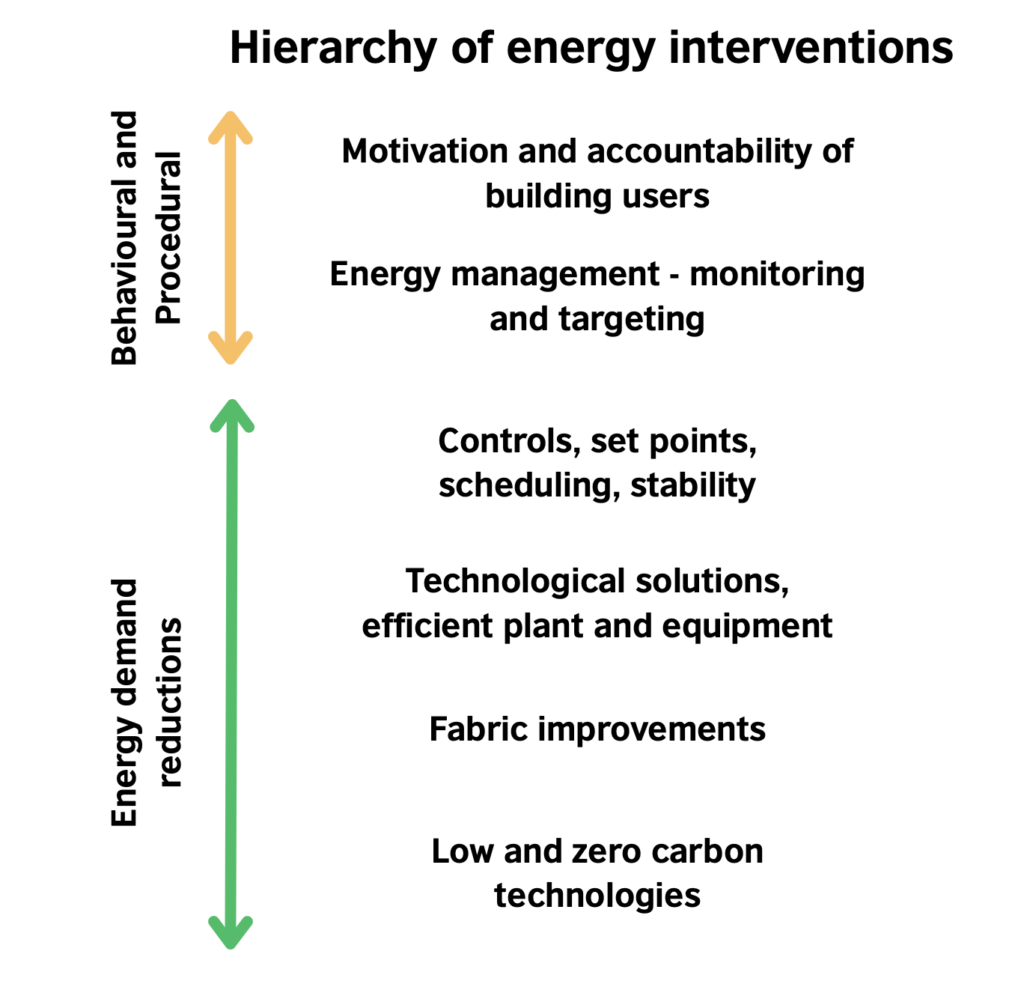
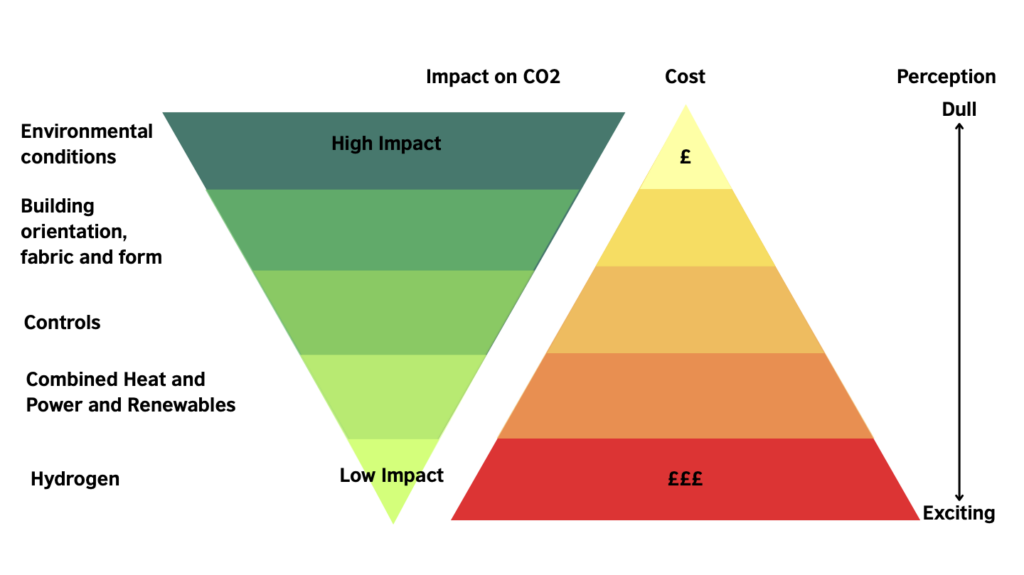
To better insulate its building, Keswick Alhambra was able to replace external windows and doors to reduce heat loss and install underfloor insulated pipework. The latter was, however, a major challenge in a heritage building. Following this, they looked into installing a heat pump, but this was ruled out as the building wasn’t well enough insulated for it to be effective, so they went for solar panels.
Savoy Cinemas, an independent cinema chain with eight cinemas, prioritised investment across its cinemas based on historic inefficiencies, high levels of gas use and payback estimates. They decided against heat pumps based on initial payback periods and the disruption involved in retrofit installation. They have invested in a range of solutions including laser projectors, LED lighting, smart controls, solar PV and battery storage, low-flow taps and dual-flush cisterns.
Check out
- Film Hub North’s DIY Retrofit Guide for an overview of low and medium-cost energy projects
- Screen Savers webinar on energy saving for cinemas (a JB-BFI resource).
4. Be resourceful, creative and collaborative in HOW you develop your capital project


Think about how you can do things differently or even find new ways of doing things. Involve others in the process e.g. staff, building users, local community groups or green technology service providers.
Connect with others who may be able to help e.g.
- community energy organisations
- other exhibitors who’ve already done something similar
- local businesses or suppliers who provide green products or services
- local council climate or environmental teams
- community or environmental groups who have shared interests
- local universities
The Royal Exchange Theatre’s The Den is a travelling pop-up theatre, funded by the Oglesby Charitable Trust. It was designed as a low impact space and can be assembled to temporarily inhabit existing spaces. It requires no heating, runs on low energy equipment, is made from sustainable and natural materials and uses seating made from cardboard.
The Courtyard Hereford collaborated with CoMo UK (national charity for shared transport), the local council and Wenea, an electric vehicle charging company. This collaboration helped it to secure funding for a range of measures to promote sustainable travel to its audiences, from bike storage to electric vehicle charging points.
Yorkshire Film Archive measured impacts and identified actions with support from environment studies students from University of York, via its sustainability clinic which supports local organisations.
SAIL in Leeds has secured funding from North East & Yorkshire Net Zero Hub to explore a community energy model for the creative and cultural industries. They have partnered with Opera North and energy consultants Scene to investigate what a community-owned renewable energy project would look like, assessing technical feasibility and ownership model of a large solar array owned by SAIL members. Check out BFI FAN’s Green Hour: How Can Community Cinemas Become Community Energy Heroes.
5. Be clear on WHO needs to be consulted, involved, trained, and informed, at what stage and how


Whatever the size and complexity of your project, be clear from the start on who needs to be consulted, involved, trained, and informed, at what stage and how – from funders, planners, contractors and suppliers to the people who will operate new spaces, equipment, plant, vehicles or systems and the people who work in, use or visit a space.
Consult with specific groups and people who will be impacted by the changes e.g. from a comfort, well-being or accessibility perspective. Create a shared understanding of what you are trying to achieve and what it will involve. Think about what you need to do to ensure that once the project is complete you have the training, knowledge, procedures etc. to make it work.
MAC Birmingham has a dedicated senior staff member with technical facilities expertise who leads on their environmental and energy projects and shares knowledge across the team to bring everyone on board with the capital investment needs. Staff and customer buy-in has been a crucial part of Savoy Cinemas’ environmental journey. Senior leadership was actively engaged in its environmental initiatives from the outset. They now have a Sustainability Lead. Cinema managers and frontline staff have been engaged in developing environmental projects through workshops and a staff-and-customer travel survey informed a range of measures to promote low and zero carbon travel.