
Materials & Waste

Key questions
What are the main types of materials and products you spend your money on?
How much and what type of waste do you generate and how is it dealt with or disposed of?
Where can you make changes directly e.g. choice of office supplies?
Who do you need to work with to make changes?
What do you know about the environmental credentials of your suppliers?


Linear vs Circular Economy
Focus first on how to avoid and reduce material use and waste. Source materials and products which are better for planet and people. Make sure that as little of your waste as possible ends up in landfill or incinerators.
Watch a recording of our re-thinking materials and circular economy webinar.
Top Tips
- Make sure there is a clear approach to separating, storing and managing your different waste streams – regularly occurring waste such as paper, cardboard, plastic and general waste, food, batteries, toners, and, waste which occurs on a more ad hoc basis e.g. WEEE, old furniture and fittings, wood, used paints or solvents. Read more about waste management in buildings.
- Share and communicate with your staff, cleaning contractors, audiences, visitors, event attendees etc. what you are doing and what they can do to help.
- Understand what materials come into and leave your organisation (buildings, storage, events, exhibitions, festivals or tours).
- Identify the main materials and products you purchase (e.g. office supplies, print, event/exhibition materials, food and drink, equipment).
- Build a clear picture of the types and volumes of waste you generate, how it’s managed, and by whom.
- If you run festivals, events, exhibitions or tours, start by focusing on one.
- Work with waste contractors to improve the quality of data you receive, or consider switching providers if needed.
- Explore consolidating multiple waste services under a single contract where possible.
- Engage landlords, local authorities and venue managers to help you better understand waste management.
- Identify key partners needed to make changes (e.g. suppliers, designers, staff, audiences, service providers).
- Consider commissioning an independent waste audit.
Use your purchasing power:
- Choose a small number of priority materials, products, events or activities to focus on, based on spend, environmental impact, brand visibility or level of control.
- Start making changes. Refer to the materials choice hierarchy below and consider life cycle impacts i.e. what is the material or product made from, where does it come from, who made it, how is it transported, what impact does it have in use and at the end of its use.
- Create ‘preferred’ and ‘red’ lists for suppliers, materials and products. For e.g. printers which use non-toxic inks and processes, Forestry Stewardship Council wood and wood-based products, recycled or sustainably sourced and unchlorinated paper, no vinyl in signage and banners, no PVC, no polystyrene.
- Work with existing suppliers to understand their environmental credentials and sustainable options.
- Apply these criteria when making new purchasing decisions and selecting new suppliers.
Take a step back and ‘rethink’ your needs:
- What do you actually need to deliver your work?
- Are there alternatives to buying new (e.g. hire, share or borrow locally)?
- Can you develop new approaches e.g. designing exhibition or events displays for disassembly and reuse or putting this in the design brief?
- Can you reduce demand (e.g. smaller print runs, print-on-demand, less or no merchandise, reusable signage and banners)?
As a general rule, follow the materials choice hierarchy when selecting and acquiring materials (1 being the best choice and 6 the last resort):
- Avoid unnecessary materials use or purchases.
- Hire or borrow materials.
- Use reclaimed, repurposed or recycled materials
- Choose low impact materials; natural or organic; sourced with care for nature and human rights; non air-freighted; energy and resource efficient; non-polluting and non-harmful to human health in use; made or supplied by companies with strong environmental and ethical credentials.
- Choose materials which can be returned, repaired, reused, or recycled at the end of their use.
- Avoid or limit high impact materials; virgin materials; materials which contain toxic or polluting chemicals or substances e.g. PVC, solvents; fossil-fuel based materials (notably single-use plastics); materials which generate hazardous waste at the end of their use.
Materials & Waste resources

Julie's Bicycle – Culture Beyond Plastic: Understanding and Eliminating
Developed under Arts Council England’s programme, this report examines plastics’ environmental impacts and how the creative sector can reduce pollution.
Read more
Julie’s Bicycle Guide ‘Raising the Bar: Choosing the Most Sustainable Cup Type for Your Indoor Venue’
This report supports indoor venues with guidance on sustainable cup solutions, summarising findings, current UK practices, and best-practice recommendations.
Find out more
Culture for Climate Scotland – Guide to preventing, reducing and recycling waste
This guide outlines Scottish arts organisations’ waste responsibilities, featuring Green Arts Initiative case studies and links to further resources.
Find out more
Sustainable Procurement Guide
A practical guide from Film Hub North to help cinemas, festivals and screen organisations make more sustainable supplier decisions.
Find out more
Julie’s Bicycle and Seacourt – Closed Loop Printing Guide
This guide is based on Seacourt's Planet Positive Printing approach and provides information for creative organisations on sustainable printing options.
Find out more
BFI Film Audience Network – Green Hour – Sustainable Procurement
This webinar explores ethical, low-carbon procurement, sharing practical examples and benefits of responsible, place-based sourcing from arts sustainability leaders.
Watch the webinar
Manchester City Council – Reusable Cups at Events: Why it matters and how to do it
This guide supports event organisers with advice on reusable cup systems for indoor and outdoor events of all sizes.
Find out more
Hubbub – Reuse systems unpacked: challenges and opportunities for food and drink packaging
This guide explores the challenges and opportunities for reusable food and drink packaging.
Find out more
Julie's Bicycle – Re-thinking Materials and Circular Economy
This webinar explores ecological and circular economy principles, showing how sustainable design and materials can transform creative and cultural organisations.
Find out more
Julie's Bicycle – Waste Management in Buildings
This guide provides practical waste management strategies for cultural buildings, covering waste types, treatment, and short, medium, and long-term solutions.
Find out more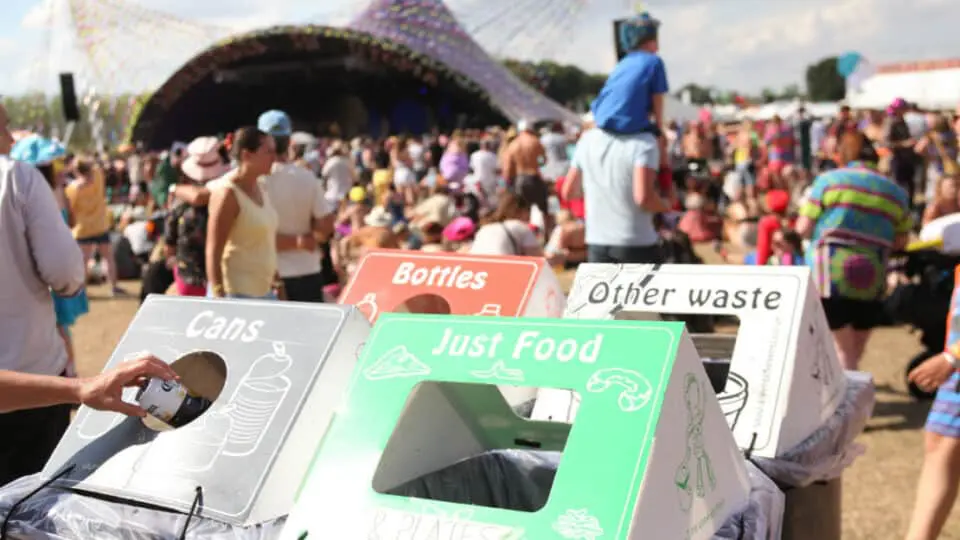
Vision 2025 and Julie's Bicycle – Sustainable Materials and Waste Management
This toolkit, part of Towards Zero Waste Festivals, offers festival organisers practical guidance, checklists, and templates to reduce waste and encourage reuse.
Find out more
Circular Economy Networks Report and Directory by the Arts Council England
This report examines how circular economy networks support the arts, with a directory of relevant networks and resources inside and beyond the sector.
Find out more
Julie's Bicycle – Can We Make Touring Greener?
Reflections and recommendations on greener touring and green riders – how to approach and what to ask of host venues.
Read moreMaterials & Waste Examples

Event Cycle connecting events to communities, theatres and charities to upcycle materials
Find out more


What does circular printing look like – case studies from Hampshire Cultural Trust and Koestler Arts
Find out more


Image Credits — Julie’s Bicycle