
Across the arts and cultural sector, a growing movement of organisations and practitioners are already building deep connections with the communities most impacted by climate change, holding space for difficult conversations and helping people co-create the adaptation strategies and responses they actually need. As climate risks intensify, the pathway to building resilience is through centring equity and inclusivity to respond to what matters locally, both now and for the future.
We designed our Leading Resilience programme to support creative organisations and networks to understand the roles they could play in co-creating better futures, and how to take practical steps to adapt, build stronger partnerships, and lead climate resilience efforts in their communities.
In 2026, Julie’s Bicycle delivered two place-based programme strands: Adaptive Futures: Bradford and the Creative Climate Accelerator Bradford, both part of the Environmental Responsibility programme delivered for, and in partnership with, Arts Council England.
Written by Vicky Sword-Daniels and Hannah Graham, Arts Council England Environmental Programme Leads at Julie’s Bicycle.
Building on our place-based pilot Resilient Horizons in 2024-25 – in collaboration with 15 Creative People and Places consortia across England to develop community-led climate adaptation responses – we wanted to deepen our work within a single context. While we had seen examples of creative practitioners and organisations uncovering differential climate impacts in communities, raising awareness, and envisioning alternative climate futures, we also identified a need for coordinated partnerships to drive long-term, community-led adaptation. We designed our Bradford programmes, Adaptive Futures and Creative Climate Accelerator, to respond to this need.
Adaptive Futures: Bradford
In this programme strand, we wanted to work in a collaborative, connected and locally grounded way, and we wanted to support practitioners to integrate justice and diversity as a core part of developing local culturally-led climate responses. Whilst our Resilient Horizons pilot was delivered online, we decided to engage in person in Bradford. This enabled us to better understand and respond to the local context, allowing time for trust and relationships to develop and to create experiential opportunities for participants to explore creative approaches. To enable greater creative freedom throughout the process, we chose to design spaces to cultivate a sense of safety, relevance, connection, bravery and joy – both in the room and in the work.
Creative Climate Accelerator
The Creative Climate Accelerator is a training programme for underrepresented groups within the cultural sector that aims to support creative and community freelancers and practitioners to step into climate leadership. By running the two programmes – Adaptive Futures and the Creative Climate Accelerator – in parallel, and in the same location, we aimed to strengthen the outcomes of both, enhancing connectivity, opportunity and leadership across the cultural ecosystem.
To select where we would deliver these two programmes, we shared our outcomes based approach with the Area Leads at Arts Council England. Together, we assessed potential regions against a specific set of criteria, including: alignment with local council climate strategies, the presence of cultural organisations active in community-based environmental work, and existing regional culture-climate networks to boost engagement. Following this process of benchmarking and consulting with local authorities, we selected Bradford as our primary focus area.
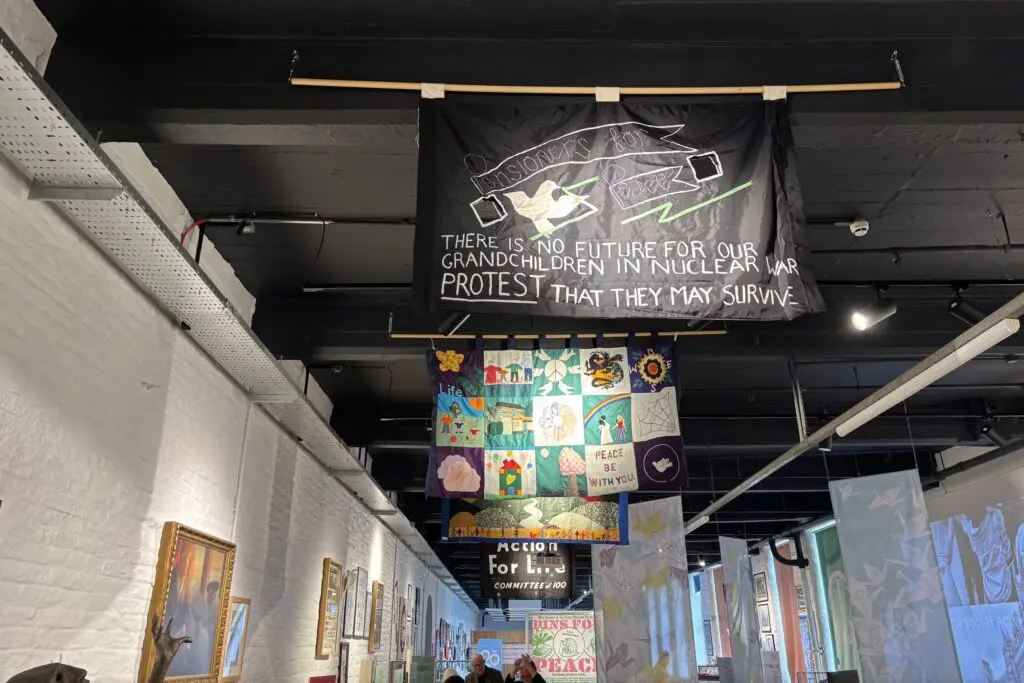
Understanding culture in the city
In 2025 Bradford hosted the City of Culture, and legacy is a key focus for the city council. Bradford has a vibrant cultural sector, one that is meaningfully connected with the communities they work with. Bradford has a diverse community with a young population, and like many other UK cities, it is experiencing the challenges of unemployment, food security, lack of secure housing, and connectivity across the city. Communities most affected by these issues also lack access to green spaces, affecting air pollution levels, urban heat and both access to and connection with nature. Community climate manifestos in Bradford include calls for more green spaces, healthier environments, inclusive activities, prioritising education for children’s futures, reliable, clean and safe public transport, community safety, and local food growing.
In the build-up to delivering our programmes, we followed an extensive process of engagement over several months, which was key to the success of the programme. We actively engaged with local organisations and aligned with ongoing, creatively led climate and cultural networks. We built collaborations through in-person meetings in October and November 2025, digital outreach, and active participation in city-wide initiatives and events. We ran a stand-alone workshop in November 2025 to engage with local organisations and freelancers, to demonstrate our approach and to gauge interests and needs, to be able to tailor our design. We continued to connect with more organisations in the months and weeks before our programmes began.
During this time, we uncovered a familiar truth. Organisations engaged in working with various communities with similar core values and intentions had little to no connection with each other. Projects that could have strengthened one another weren’t linked, and in some cases weren’t aware of each other’s existence. Yet, the richness, ambition and expertise in the room was striking. We knew that an outcome of this work would be more connectivity across these organisations and individuals, which is a core need for long-term adaptation work.
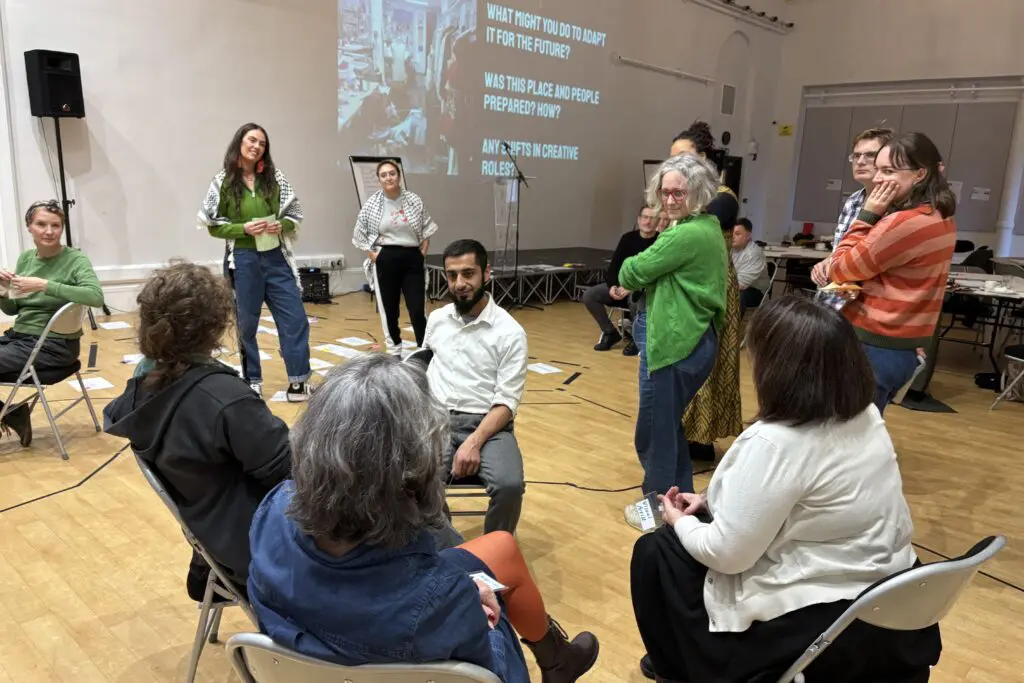
Forging connections
From the outset, our focus was to engage and upskill cultural workers and their partners to strengthen Bradford’s climate resilience. To achieve this, we worked across Bradford’s broader cultural ecosystem, uniting creative practitioners, third-sector partners, and community leaders. These included galleries, museums, theatre, art studios, faith and community groups and centres, wildlife restoration and outdoor space groups, freelance artists, and community-led cultural projects.
Leveraging their deep local connections, this collaborative network explored creative ways for engaging with the lived realities of climate change, unlocking culture’s unique potential to drive meaningful, transformative possibilities for the city. We found that a focus on the future can inspire creativity and imagination that can be prototyped and explored through different art forms, opening space for groups to engage with alternative possibilities. Drawing on heritage, cultural wisdom, and different forms of knowledge, and valuing them as a set of shared strengths can build agency to plan ahead as a diverse collective.
We designed both programmes to have whole days of connection between them, both at the start, to create connections and shared learning, and at the end, to solidify and surface emerging patterns of alignment and for partnership possibilities to emerge. We designed each programme to meet the needs and interests of the cohorts. Both programmes ran from January to April 2026 with five sessions each, in a mixture of in-person and online formats.
The programme team, Vicky Sword-Daniels, Hannah Graham and Farah Ahmed, brought specialist expertise in climate adaptation and resilience, creative facilitation, cultural strategy and climate justice. We explored adaptation through the lens of culture, and the programme team created a new Creative Adaptation Framework, translating cultural and climate resilience outcomes into work that aligns with the local outcomes needed for each place. We used this framework to guide the engagement process, revisiting it throughout the sessions to deepen learning.
In the room: shaping the sessions
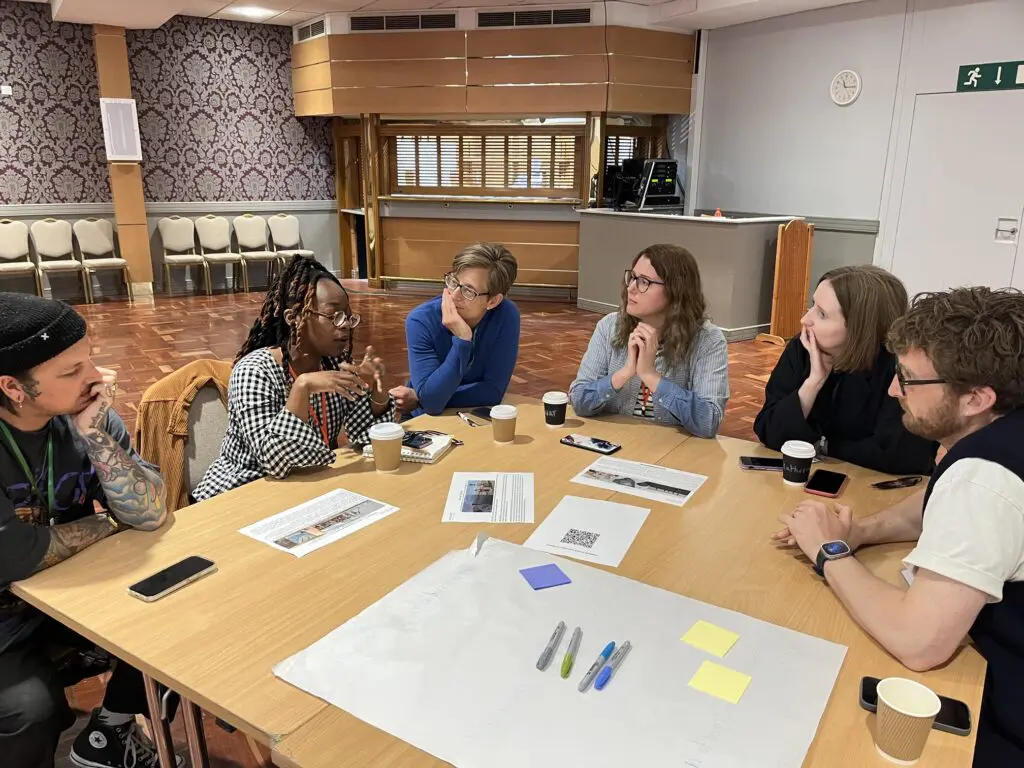
Our approach to delivery was as intentional as the work, without over-designing the space we encouraged co-design and feedback throughout. We mostly used the hall space at Bradford Arts Centre, though we were nowhere near the max 70 person capacity. This work needs space, literally and metaphorically and whilst on the ground work might not always be offered that luxury, we wanted to explore how we, by arranging the room to encourage openness and conversation, broke down any perceived hierarchy between us. We had a ‘bike rack’ (a nod to Julie’s Bicycle) for parking ideas that need future exploration, a reflections board and a ritual of reviewing our group contract before in person sessions. Tables were set for doodling, with images and case studies spread around and often covered with biscuit crumbs and empty tea cups by lunchtime. We had catered for dietary needs, however we had forgotten about ordering gluten-free biscuits! This small but important detail was shared back to us anonymously in our feedback board and changed by the next week. Other reflections and feedback over time followed a similar pattern, ensuring both the work and the conditions for working were iterative and responsive.
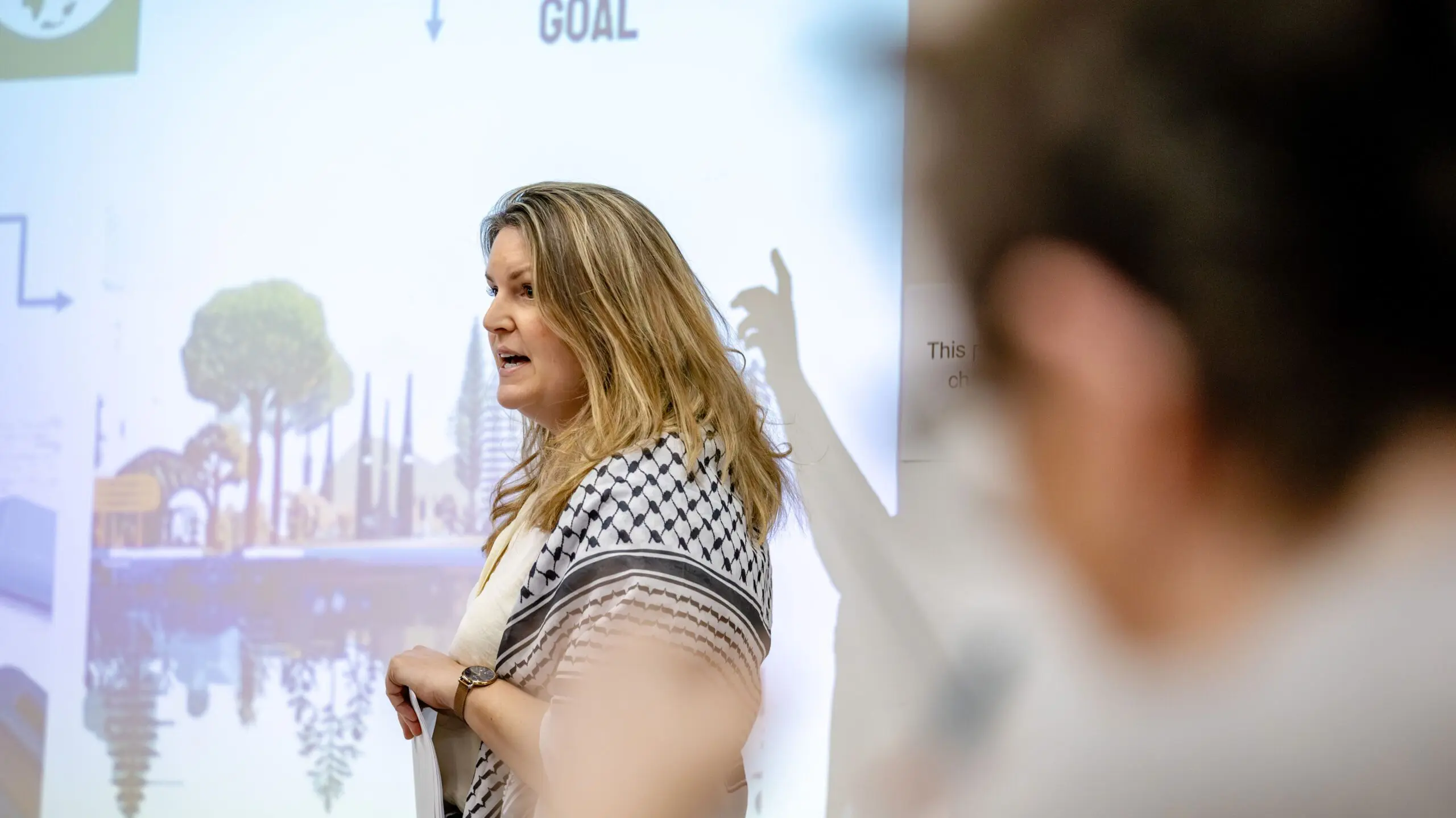
Our first full-day workshop focused on connecting to and understanding place, local knowledge, projects, and the foundations of climate justice and adaptation. We also explored principles for adaptive futures, alongside an immersive audio experience made in Bradford. Following this, our Creative Climate Accelerator cohort explored biodiversity, material systems and imagination infrastructures. The Adaptive Futures cohort examined local climate futures and local connection, cultural routes to adapting within place, systemic drivers of inequality and explored creative forms as a force for change. Find out more about our workshops in Bradford in this blog.
Throughout the programmes, we kept the sessions flexible to enable us to revisit and solidify content, dive deeper into areas needing further discussion, or allow for more peer discussion on new learning, concepts and ideas. As a small team, we reflected together on what landed, what needed scaffolding or landing differently next time, what we needed to include next, and what worked. We sought and included feedback from people in every session, and as trust grew, so did the groups’ confidence to share with us how we might adapt delivery next time. We made our focus on learning and experimenting with approaches ourselves clear, and a sense of ‘all being in it together’ fostered a creative and co-design atmosphere in these spaces.
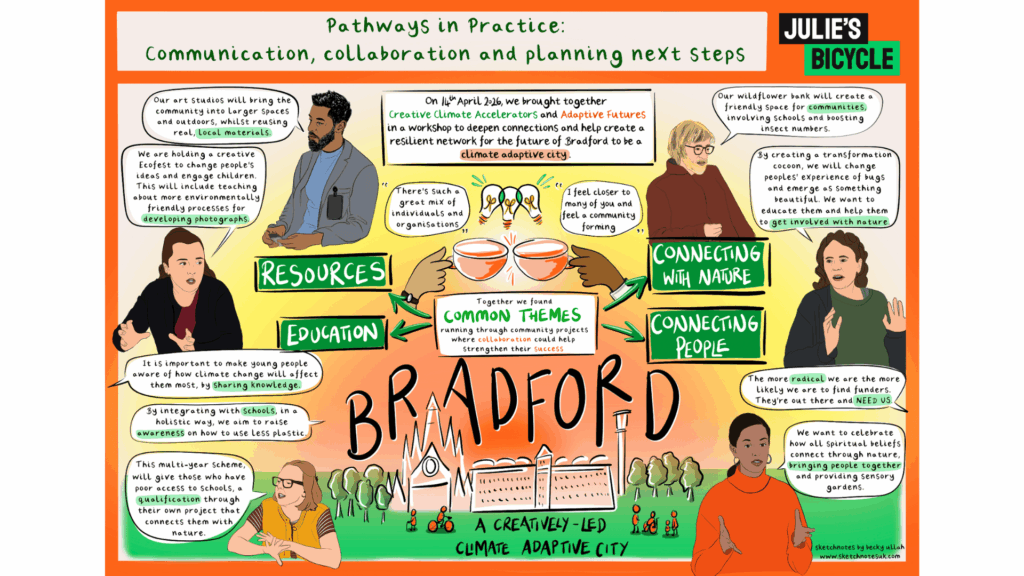
Our final one-day workshop brought both programmes together again for reconnecting, creative inspiration, project planning, role play exercises, and sharing new and next ideas across programmes. Becky Ullah joined our final workshop and created sketch notes of the themes and projects emerging from the programmes (image below).
Reflections and next steps
Participants placed themselves on a self-rating scale at the first and last sessions, in their understanding of climate adaptation, the roles that arts and culture can play in supporting communities to adapt, and their connection to other people doing this work in Bradford. The group shifted positively on all aspects, and following the final workshop, chose to create a network to continue to share opportunities and support each other in this work. The group told us that they felt more connected to one another, had a deeper understanding of the work and the possibilities for it, plus a sense of being a part of a community working on something deeply important. Our Creative Adaptation Framework helped to translate and guide people’s thinking and deepen understanding of this work. The space to engage with this throughout the process, create new ways of encountering it, opportunities for experiential learning and practical project planning, demystified and distilled an already-deep understanding of how to do this work within communities, and brought imagined futures into achievable practice.
We will continue to follow-up with and support Bradford’s emerging network of creative and cultural leaders in developing community-focused adaptation projects. We will share more of this work as it emerges and takes shape in the months and years to come.
Spread the word