
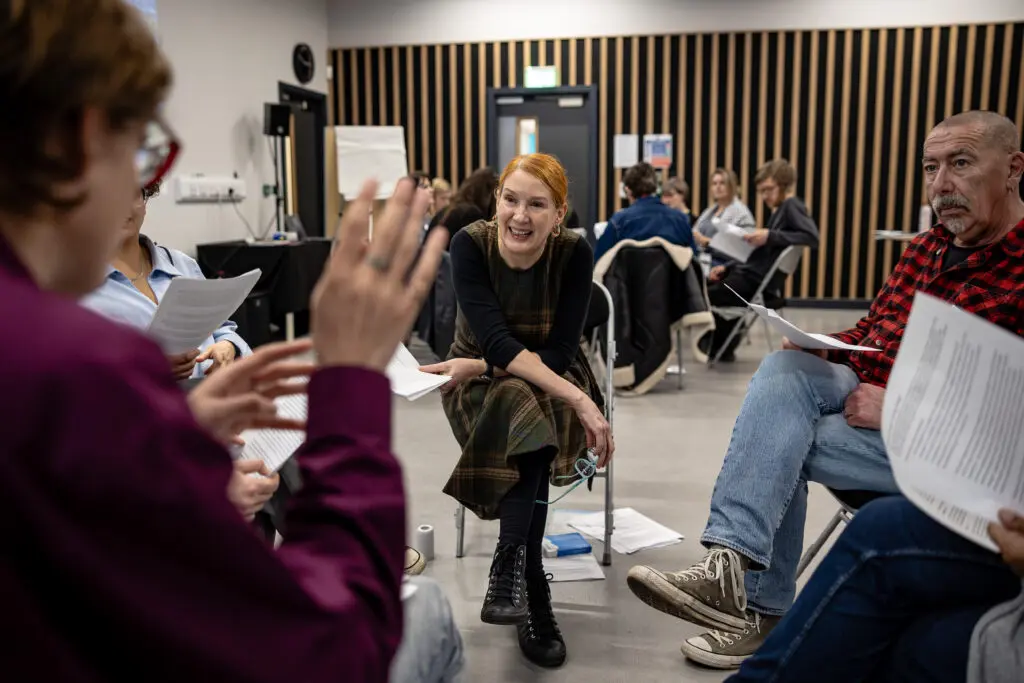

WRAPPING UP workshops, explorations and creative conversations at Adaptive futures: Bradford.
Between February and April 2026, we brought a series of workshops on place-based climate adaptation and resilience to Bradford, called Adaptive Futures: Bradford. These sessions united cultural practitioners, community leaders and local experts in one shared goal: to explore how creativity can support place-based climate adaptation.
Hannah Graham, Arts Council England Programme Manager at JB, reflects on the programme and shares her insight on the final sessions.
Adaptive Futures: Bradford was delivered as part of our Adaptive Futures and Creative Climate Accelerator programmes, through our partnership with Arts Council England.
In April, we concluded the Adaptive Futures: Bradford programme, with a final session that brought the together cohorts from both the Adaptive Futures (blended sectors and individuals group) and Creative Climate Accelerator (creative professionals).
In the morning, the energy of the room felt charged with anticipation and curiosity. Bodies leaned forward to hear from our guest visiting speakers, artists, activists and leaders of organisations who have explored building climate resilience and adapting to climate futures through a myriad of projects. Matt Denham from D6 spoke alongside Kaajal Modi and Emmanuela Yogolelo, who together explored topics like:
- artist collaborations in community gardens by exploring community-led responses to heat in five Mediterranean hotspots
- the artistic exploration of food systems and regenerative practice
- storytelling through spices, plants and culture
- music and storytelling to connect with climate and environmental justice, history and cultural wisdom.
Throughout this programme, we have aimed to bring in as many examples of this work as possible, including projects that have already taken place locally. Seeing this work in practice helps participants understand the theory and inspires them to develop their own approaches to adaptation.
In the morning, the energy of the room felt charged with anticipation and curiosity. Bodies leaned forward to hear from our guest visiting speakers, artists, activists and leaders of organisations.
Bringing the two cohorts together also had a huge impact – especially for those who don’t see themselves as creative. Now, during the in-between moments, people can pull up chair next to an artist, describe a hazy half-formed idea over a cup of tea, and by the time the cup is empty, their idea is considerably clearer! This means that in the margins of the workshop, a lot can happen.
Giving our ideas a chance to settle deeply
First, Vicky set the day up by recapping the key content and allowing the group space to let their learning breathe. With so much covered across the programme, through new models, new language, new ways of seeing, we wanted these ideas to settle somewhere a little deeper before returning to them practically. After a break, the groups split.
The Creative Climate Accelerator broke into smaller groups to deepen their individual project ideas, with each one mentored by one of the three speakers, while The Adaptive Futures group moved to a side room that almost entirely glass with sun spilling in, a cathedral and its gardens framed perfectly beyond the windowsill that was covered in living plants – a space that felt like the right container for the discussions.
I presented worked with the Adaptive Futures group, and presented Cloudspotting by Raquel Masseguer, which explores resting spaces for people with disabilities and chronic pain, and engaged young disabled activists. It had a specific Coventry iteration in 2022, was also a project I had previously worked on.
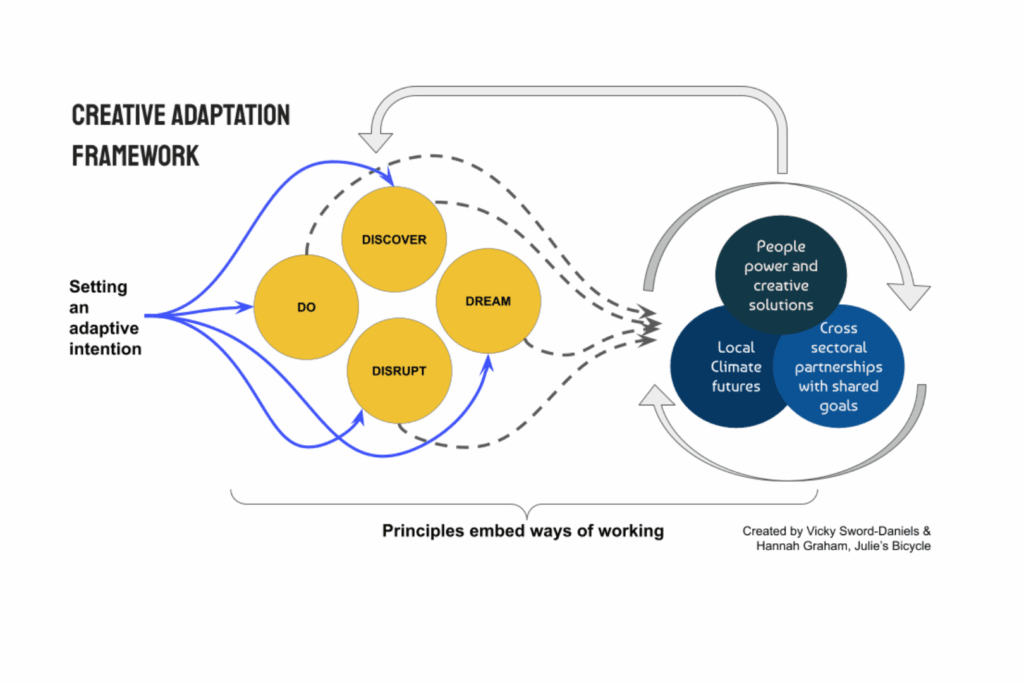
Working with our Creative Adaptation Framework, we began retrofitting the project together, exploring how Cloudspotting‘s alternative inception might weave in adaptation more intentionally. The room began thinking in systems.
We imagined resting spaces that considered not just physical access but the temperature realities of a two degree future, infrastructure designed to include shelter and the compounding impacts of climate futures on people with multiple or profound disabilities.
Within 15 minutes, pages were full. There were diagrams, written intentions, even physical designs of structures that could well exist in the imagined future Bradford.
Moving from this group work, everyone was invited to individually write about, draw and evolve their project ideas the old fashioned way, on rolls of paper or poster in pen, felt or pencil. They chose to work to the sound of thunder and rain, which seemed to focus and draw out their creative ideas at an accelerated rate.
Within 15 minutes, pages were full. There were diagrams, written intentions, even physical designs of structures that could well exist in the imagined future Bradford. Each project idea was set against one of our 4D intentions – to discover, dream, do or disrupt – focusing the project from the outset but never stopping in that place, and always with a second (or sometimes third) intention to move towards.
The group mapped how climate futures, community strengths and strategic partnerships (our ‘elements’ in blue circles below) might be embedded within the work from the outset, to realise intentions through creative approaches, underpinned always by the principles we had identified and agreed on.
Practicing the pitch
The trick, as with all good ideas, is to get buy-in. From funders to the local cabby or simply the next door neighbour who seems to know everyone.
Vicky refreshed their learning from a previous session led by Farah, which uses the idea of the ‘back of an envelope’ approach, covering your memorable conversation lines, key needs and hooks. Together, we demonstrated how the conversation could look in real life, fielding push backs in the form of climate anxiety, general apathy or denial.
Practicing in a safe space allowed them to find their own way of talking about climate adaptation, by hardly saying those words at all and instead focusing on the positive outcomes
In pairs, each person practiced pitching their idea to an imagined local person, finding connections to spark curiosity that might lead to someone joining a project meeting, being creatively involved in some way or simply telling others about it. With any creative idea, especially when weaving in climate change, this is often the hardest thing to do – it is a skill of distillation, taking something that has been building for weeks and landing it with conviction and a warm smile.
Practicing in a safe space allowed them to find their own way of talking about climate adaptation, by hardly saying those words at all and instead focusing on the positive outcomes such interventions might look like within Bradford. Concretely, joyfully and possibly soon!
Mapping the common threads
After lunch, the two groups sat in a circle and took a minute each to share their idea again, this time to everyone.
We listened and mapped the common threads emerging across the room, then handed out sachets of tea and asked people to write their preferred contact details on the label and give it to someone they wanted to connect with.
I’ve used this idea in many settings, sometimes people even take the tea to their next meeting. Sometimes it sits in the cupboard for a few weeks before someone opens it and thinks “oh, I must call that person about their project!” I have sometimes heard years later that the cup of tea started a new partnership or project that lived on and outlasted the project that gave it away.
Vicky closed with one of her favourite, grounded evaluation exercises, asking participants to identify what they would expect, like, and love to see within their projects. It’s a smart way to independently identify a loose Theory of Change, it surfaces actions, assumptions, outcomes and potential challenges to navigate. I think this anchors the idea back to the original intention, and keeps the principles alive when the real world pushes back.
Riding the wave of high spirits
As we reached the final hours, the room was filled with laughter, celebrations and deep listening, as it filled up with the energy of people who are ready to start something.
This is the magic that becomes the turning point and as facilitators, we had the honour of watching it arrive. It is uncontainable but contagious – the moment where the collective sense of shared purpose tips into wanting to take action and make something positive happen, whether that’s tomorrow, next week or next year.
As we reached the final hours, the room was filled with laughter, celebrations and deep listening, as it filled up with the energy of people who are ready to start something.
It was at that moment we asked who would want to stay in touch via a Whatsapp group and everyone agreed, even our creative mentors wanted to stay close to what had been built in the room. We closed with a final check in, in the form of a physical line to help us measure confidence, connectivity and understanding of how culture can lead creative adaptation work.
Whereas the first session’s line-up had seen people had been scattered across the line, but now most stood towards the top end across all three questions. No one claimed to be an expert but the group looked like a small murmuration, moving and swelling together with smiles at the higher end. We documented the visible shift.
The programme finished with celebration over a group curry, riding the wave of high spirits over dhaal and chickpeas.
We’ll stay in touch with the group, and have begun to spot see weekly posters and events popping up in the group chat, showing that this work is already living on through them. In six months, we’ll invite them back for a (Yorkshire) cuppa ourselves and to see how things are evolving – there’s no doubt they will have!
Photo by Karol Wyszynski
Spread the word