

Cultura Circular was a capacity-building programme for arts and culture festivals across Latin America and the Caribbean, delivered by Julie’s Bicycle with support from the British Council Americas. This case study highlights the work of the Lima PUCP Film Festival in Peru from the programme’s 2025-2026 cohort.
The Lima PUCP Film Festival
The diversity of landscapes and geographies is a distinctive feature of Peru. Against this backdrop, festivals emerge as places of celebration and spaces of fertile action where new responses to the environmental crisis are woven. We present the work of the Lima PUCP Film Festival, one of the festivals participating in the Circular Culture programme in Peru, which is supported by the British Council and in which Julie’s Bicycle provides training and support for the organisers. On the urban coast of Lima, the Lima PUCP Film Festival creates innovative formats that integrate memory, territory, and environmental awareness. Below is a detailed review that demonstrates how culture can redefine the encounter between people and nature.
Approaching its thirtieth edition milestone in 2026, the Lima Film Festival of the Pontificia Universidad Católica del Perú (PUCP) aims to be a true “ritual or festivity that revolves around the act of seeing, enjoying, feeling, and sharing Latin American and world cinema.”
Every August, for ten days, the festival brings together a community of diverse “voices and perspectives,” composed of creators, cinephiles, new enthusiasts, and transient visitors, who gather each year to experience the magic of cinema and celebrate the region’s customs, stories, and languages.
Its activities include an extensive programme and competitions for official awards in the categories: Peruvian competition, Latin American fiction competition, and Latin American documentary competition. These are added to the distinctions and incentives granted by international critics, the public, and the PUCP community. The proposal is complemented by screenings, a programme of meetings, the Industry Zone focused on the development of national cinema, with its work-in-progress (WIP) and LAB projects, and laboratory sections featuring prominent industry figures.
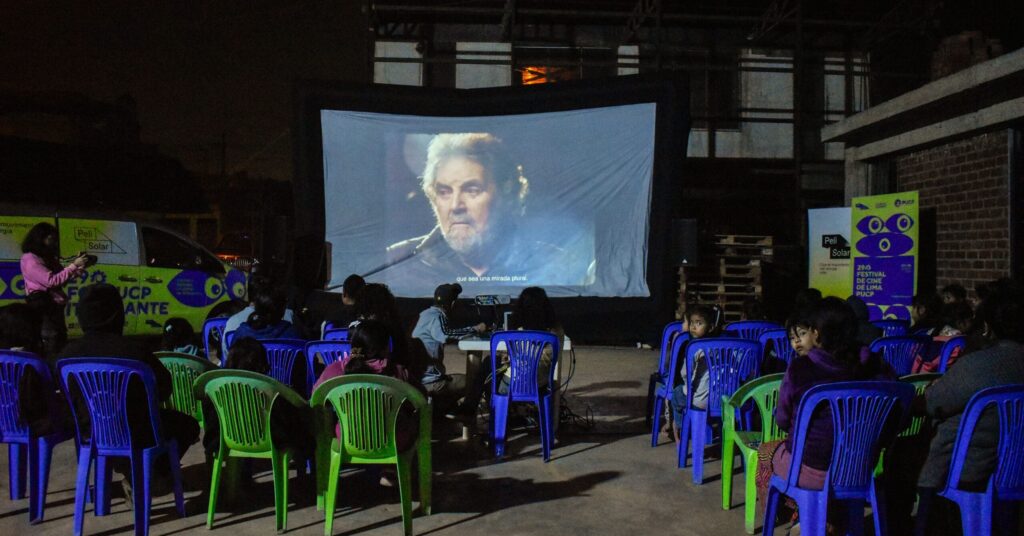
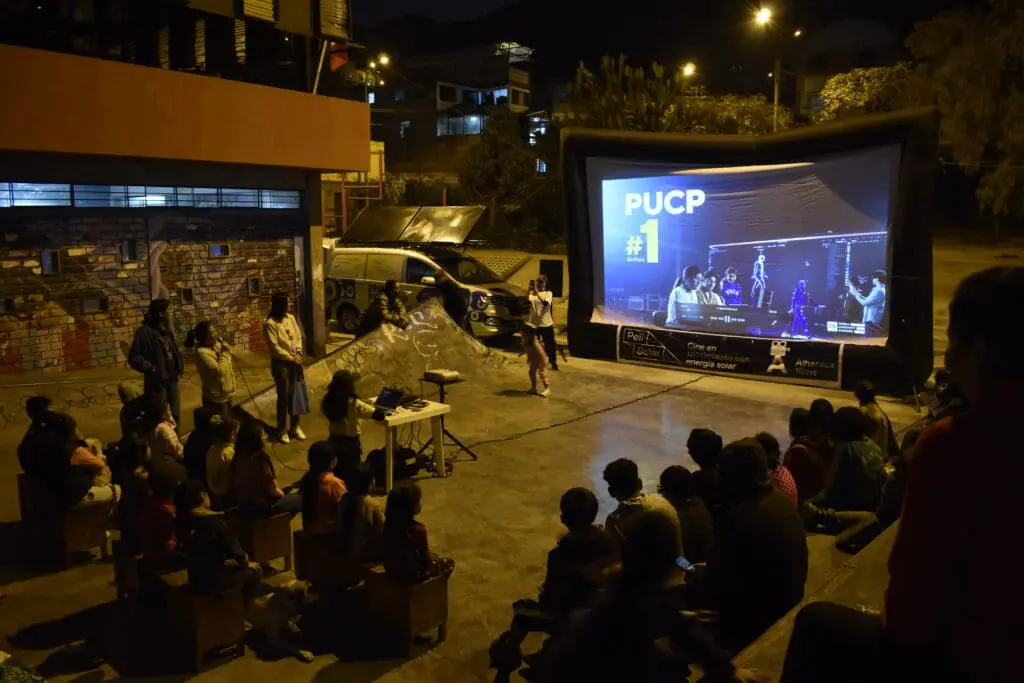
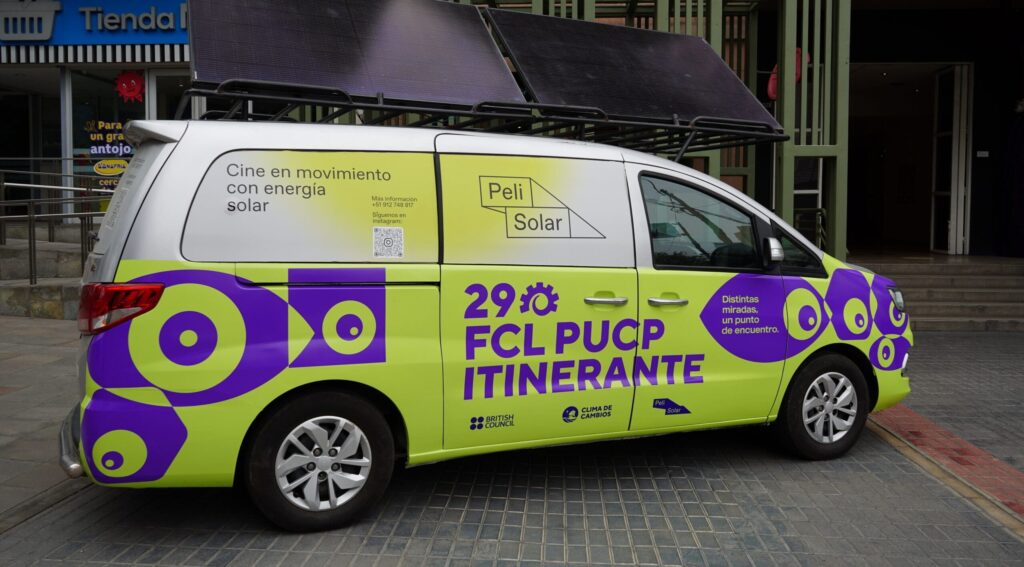
Its innovative spirit continues to evolve towards formats that broaden the commitment to the territory and sustainability. An example of this is its itinerant section, which is committed to “decentralising access to culture and strengthening collective memory through audiovisual language.” Thanks to a strategic alliance with the British Council and PeliSolar, the festival has deployed Peru’s first mobile cinema powered entirely by solar energy. Using inflatable screens, films are projected in public, open-air spaces with open and free admission, in the Lima districts of Huachipa, Cantagallo, and Comas, complementing the section that also seeks to disseminate cinema in a decentralised manner in Trujillo and Puno.
It is a “new route toward community cinema” in which citizen participation is the driving force of the event. The programming was selected jointly with neighbourhood collectives to open genuine conversations about the “environment, its stories, and challenges.” Furthermore, the University made a symbolic gesture by adding basil seed souvenirs to the tickets to encourage spectators to sow, plant, and cultivate basil at home.
Building environmental awareness is a collective process for the festival, which is why they convened “Clima de Cambios” (Climate of Changes), an environmental initiative of the PUCP, whose mission is to inform, raise awareness, and activate the university community about the impacts of climate change and the institution’s actions for environmental care and protection. Likewise, they had the support of the Municipality of San Isidro for solid waste management.
In this edition, a group of fifty young people participated in training on solid waste management, recycling, and composting. In addition to actively working on awareness campaigns aboutwaste separation at the source, eco-friendly transportation for the public and guests. The strategy was completed with a video whose message is: “sustainable culture cares for the planet through every story, every perspective, and every seat.” This material was projected at the beginning of each screening to guide and motivate the public toward more sustainable behaviours.
Furthermore, this edition included advice from Capaz Perú, an organisation that promotes the comprehensive inclusion of people with disabilities in the cultural sector, to provide a more accessible experience. Inclusive screenings of the Spanish film “Sorda” (Deaf) were programmed, in which the protagonist faces the challenges of motherhood as a person with a hearing disability. A discussion was also held with the director about the challenges and lessons learned from a feature film that featured a cast of deaf actors. Although accessibility remains a challenge in cinema, through these actions, we seek to raise public awareness of the need to create more inclusive cultural spaces.
One of the organisation’s goals is to measure the set of reduction actions and strategies adopted to set long-term objectives.
As part of the festival’s ethical commitment, a “safe, tolerant, and discrimination-free space” is guaranteed. This involves attendees, collaborators, the public, and participants in protecting against any type of gender violence and discriminatory acts.
Accessibility, sustainability, and the creation of safe environments are priority objectives that express the values and principles defended by the Lima Film Festival PUCP. The “discovery of diverse universes” and “the exchange with others of the lived experience” are what happen in each edition.
Spread the word