
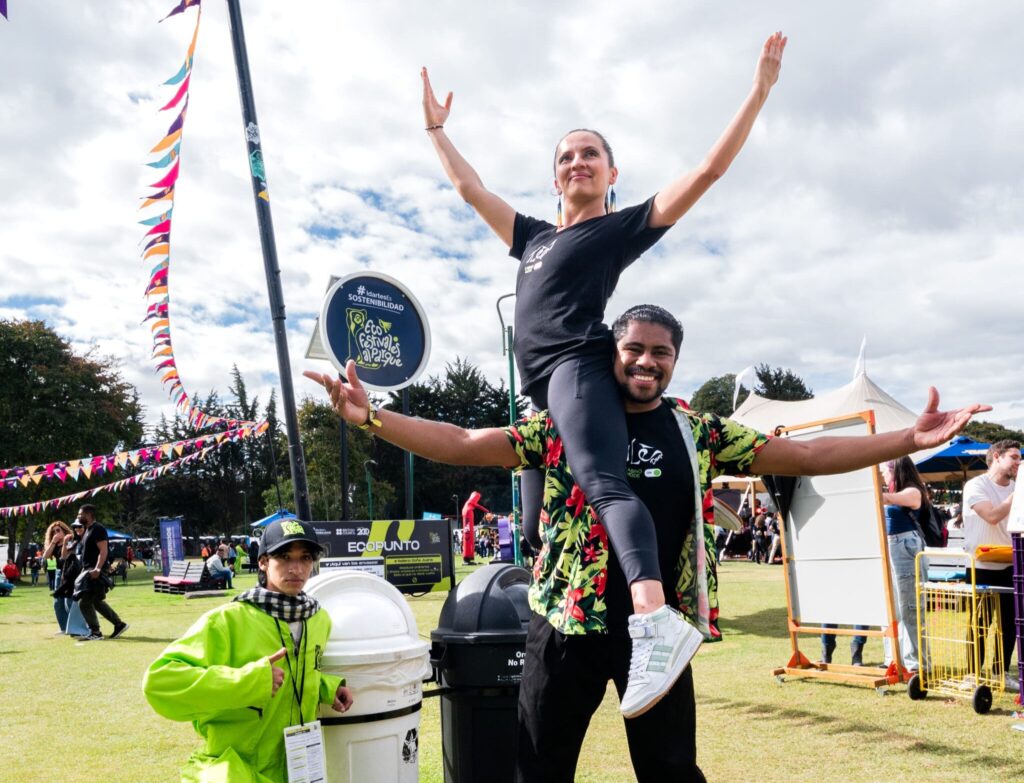

Cultura Circular was a capacity-building programme for arts and culture festivals across Latin America and the Caribbean, delivered by Julie’s Bicycle with support from the British Council Americas. This case study highlights the work of Festivales Al Parque in Colombia from the programme’s 2025-2026 cohort.
FESTIVALES AL PARQUE
Surrounded by Bogotá’s beautiful páramos (moorlands), the Festivales al Parque programme is one of the city’s main amplifiers for musical creation and circulation. Its uninterrupted trajectory began more than thirty years ago with Rock al Parque and currently includes eight diverse genres: Colombia al Parque, Hip Hop al Parque, Jazz al Parque, Joropo al Parque, Salsa al Parque, Vallenato al Parque, and Popular al Parque. All shows are free, open access, and of high quality.
Each of them is built on a cross-cutting premise: “Art transcends entertainment and is reclaimed as a place of symbolic encounter, shared hope, and restoration of the social fabric.” This programme is a true expression of the city’s identity; a space where diverse aesthetics and ways of experiencing the city are represented, highlighting its multiculturalism and inclusion.
In 2020, during the COVID-19 pandemic, Idartes conducted a deep review of its management, which raised questions about the environmental impact of large and medium-sized cultural events.
This prompted Idartes — the public body responsible for the festivals — to commit to a more conscious future. This commitment was expressed through experiences such as Respira el Arte (Breathe the Art) and Más Música, Menos Plástico (More Music, Less Plastic), leading to the idea of EcoFestivales. From the outset, Julie’s Bicycle supported this initiative. Their initial contribution included capacity-building and the drafting of a guide for festivals and theatres. This guide has since been updated, with IDARTES participating in the British Council-supported Cultura Circular programme in 2025.
This is a strategy designed for a mass audience of around 650,000 people per year, integrating sustainability into the planning, production, and experience of Festivales al Parque. It represents the consolidation of lessons learned through a participatory structure and approach, with the purpose of positioning them as “benchmarks for environmental management and civic culture” at the local and regional level.
In the 2024 edition, these were the achievements of Festivales al Parque:
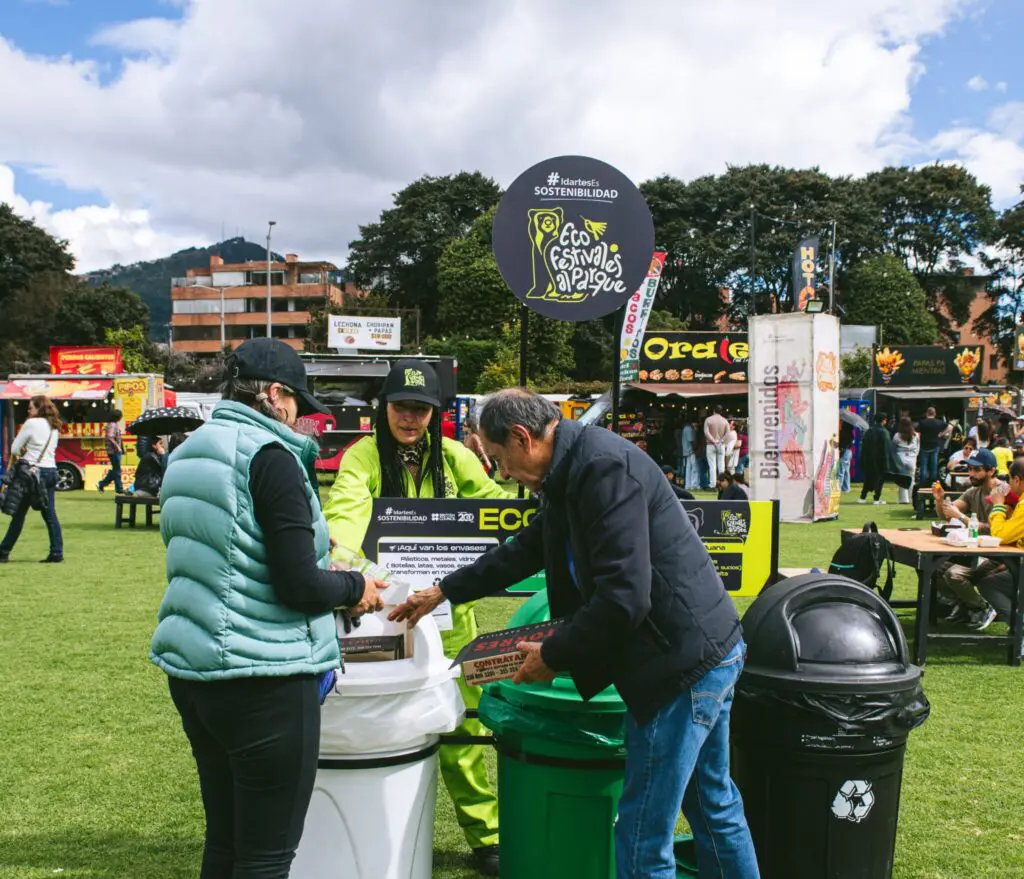
- Waste management: More than 8,400 kilograms of waste were recovered in the 8 locations and 20 ecological points to facilitate separation and recycling.
- Alliances with strategic actors: Joint work with recyclers, environmental organisations, and sponsors.
- Measurement and mitigation of the carbon footprint: Implementation of tools developed by the entity itself.
- Environmental education: Educational experiences such as “Adopta un frailejón” (Adopt a Frailejón) (featuring figures like Frailejón Ernesto Pérez) and awareness talks for the artistic sector.
The Programme Expands
Strategic Results EcoFestivales 2025 include:
- International Assistance and Technical Strengthening: EcoFestivales strengthened its international strategy and received technical support from A Greener Future (AGF) and the British Council through the Cultura Circular programme (also supported by Julie’s Bicycle). This included a comprehensive review of the Environmental Guide (waste, energy, water, purchasing, and governance), a technical visit to Salsa al Parque (October 2025), and an international master session in November 2025 to consolidate sustainability standards.
- Network of Festivals Committed to the Environment: This unprecedented network, created in 2025, brings together 12 festivals, institutions, and allies to promote collaborative cultural sustainability.
- Technical Tools for Sustainable Management: EcoFestivales consolidated three key instruments: the updated Environmental Guide initially developed with the support of Julie’s Bicycle a few years ago (with sub-guides and traceability criteria), the MVP of the Environmental Footprint Calculator, and the Sustainable Procurement Protocol (with environmental and social criteria). These tools seek a standardised, measurable, and replicable system.
- EcoCrew: Citizen Participation and Environmental Education: The EcoCrew was consolidated as the operational and educational sustainability team, with more than 120 members (promoters and recyclers). They focused on training in separation and traceability, transforming recycling points into educational spaces.
- Institutional Training for Sustainability: EcoFestivales developed internal environmental training at IDARTES, including five inter-area workshops with more than 60 collaborators to improve internal coordination, decision traceability, and communication on sustainability. Additionally, a talk was held with Héctor Buitrago (Aterciopelados) on music and artivism.
- Environmental Communication Strategy: A multi-channel strategy implemented in 2025 connected sustainability with each festival’s identity, strengthening citizen ownership. Featured campaigns: Sustainable Rocker Festival-goer Manual (Rock al Parque), The rhythm of the earth (Colombia al Parque), The beat that cares for the planet (Hip Hop al Parque).
- EcoForo 2025: International Dialogue Platform: EcoForo 2025 was the main space for reflection on cultural sustainability in Bogotá, with more than 150 participants. 10 conferences/panels, 4 co-creation workshops, and 2 laboratories were held, including the international panel Circular Culture LATAC with the British Council and A Greener Future.
- Art, Culture, and Environmental Awareness: The cultural axis integrated artistic and educational experiences. Highlights included the international exhibition Énergies Désespoirs: Un monde à réparer (Bogotá Planetarium, Alliance Française), with more than 50 works on scientific facts and environmental solutions, and immersive projections on biodiversity and climate change.
The Work Axes
According to Quena Melisa Leonel Loaiza, coordinator of the Sustainability Line for the Artistic Ecosystem, there are four fundamental axes for strengthening sustainability actions:
- Collaborative Governance in Public Management: The creation of governance rings facilitates the design of specialised protocols to address environmental impact and its mitigation, according to the roles of producers, directors, allies, and suppliers involved in the festivals. On the other hand, innovation in large public entities (such as Idartes) lies in incorporating “green logistics” into bidding processes for contracts, either as a mandatory criterion or as an additional score. This represents a great challenge for negotiation among multiple actors.
- Alliances with other institutions: “Sustainability flourishes in networks, not in hierarchies.” Therefore, collaborative work with other festivals and institutions, such as the British Council and the Alliance Française, is key to strengthening management, governance, and promotion. This was reflected in the results of the EcoForo 2025, a meeting of international experts, producers, and artists, aimed at strengthening environmental sustainability in music festivals.
- Citizen Participation and Environmental Education: Debates generated from art allow for the recognition of territorial differences and the incorporation of pedagogy, promoting experiential education and a citizen culture of care, mutual learning, and inspiration among the different festivals.
- Responsible Production and Green Logistics: Mitigation actions, such as the use of renewable energy, pose significant cost challenges. However, intermediate strategies can be developed to achieve balance and to activate actions that need to be quantified, on the premise that “Measuring makes management smarter.”
These axes mark the path toward the fundamental purpose of Festivales al Parque: that the events be experienced while caring for the territory and demonstrating that art and culture can actively help address the environmental challenges of our times.
Spread the word