
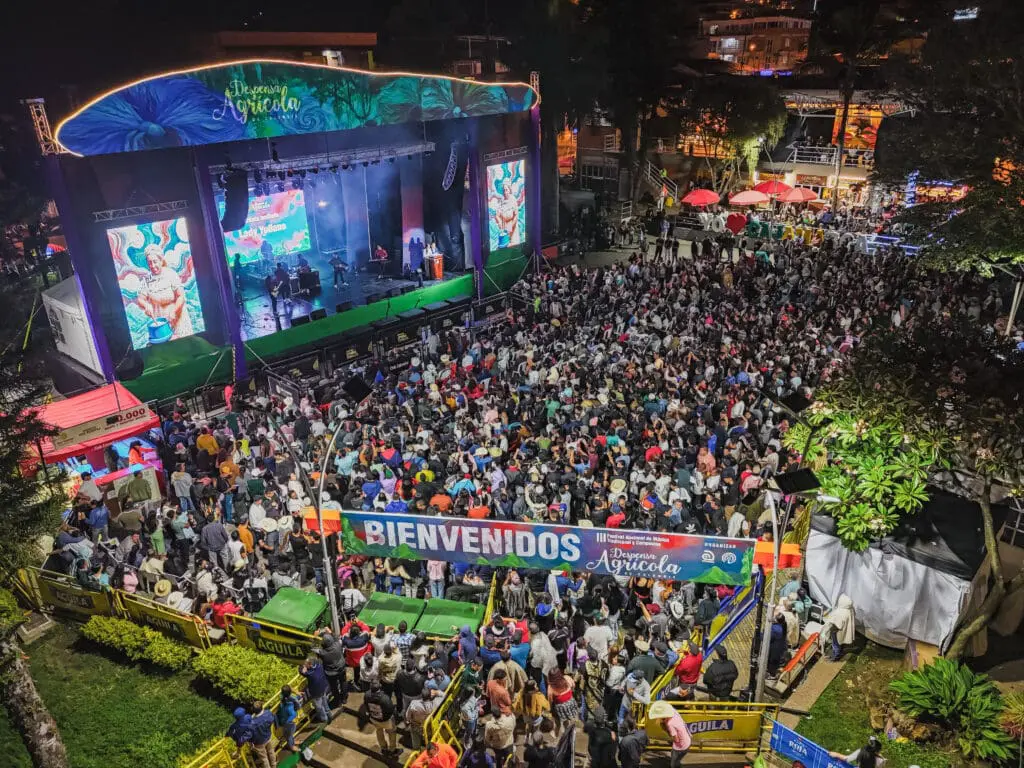

Cultura Circular was a capacity-building programme for arts and culture festivals across Latin America and the Caribbean, delivered by Julie’s Bicycle with support from the British Council Americas. This case study highlights the work of Festival Nacional de Música Campesina in Colombia from the programme’s 2025-2026 cohort.
Festival Nacional de Música Campesina “Despensa Agrícola de Colombia”
Born in the heart of the Colombian countryside, this festival is a space where music and the land intertwine. Its artists, audience, and workers inhabit this territory among fertile mountains, integrating sustainability into their daily lives.
In its second edition, the Festival’s objective is to foster artistic and cultural expressions in the municipality of Cajamarca’s rural and urban areas, as well as nationally, to preserve and disseminate the traditional and peasant music of Tolima and the rest of the country. Every two years, the event brings together about 10,000 people over three days to celebrate peasant music, enjoy typical gastronomy, learn about its traditions, and appreciate Colombian friendliness.
The “Sustainable Roots” project of the Despertarte Foundation enthusiastically organised the festival to highlight the practices that exemplify cultural and environmental sustainability in Colombia. Through comprehensive management, the festival not only consolidated itself as a space for safeguarding intangible heritage but also as a laboratory for responsible environmental practices. The implementation of strategies to eliminate single-use plastics, optimise energy resources, and create biodegradable infrastructure, such as the Tienda Circular (Circular Store), reflects a genuine commitment to mitigating climate change and respecting the rural environment.
The inspiration of Shambala Festival and mutual learning
As part of the call for the British Council’s Circular Culture programme, in association with Julie’s Bicycle, the festival received a visit and mentorship from British expert Sidharth Sharma, creative director of the renowned Shambala Festival (UK) for more than 25 years. This collaboration generated an enriching exchange of knowledge on education, economic sustainability, and environmental management, as well as in the musical field, and opened spaces for future international presentations.
For the Colombian hosts, the experience was revealing: “It was very rewarding for both us and him, who is used to seeing the field from a more industrial perspective.” In contrast, the Colombian countryside surrounding La Despensa “works with hands.” They are self-sustaining farms, where work is done manually, with a hoe and without machinery mobilised by fossil fuels. And they highlight that they produce organic food, their own fertilisers, cleaning products, and even the gas they consume.
Practices in action
The festival achieved a “tripartite” by uniting the countryside, culture, and environmental awareness, planting a seed in farmers’ minds about the importance of environmentally friendly cultivation. This union gave visibility to the people working in agroecology in Cajamarca.
We highlight:
- Tienda Circular: A decorative and functional space made entirely from organic and local materials like foliage, flowers, and natural fibres. This infrastructure reduced the event’s carbon footprint by an estimated 85% compared to conventional stands.
- Biodiversity and Food Sovereignty: The festival showcased local agricultural diversity through “Despensa Viva” stations. It supported the local economy by sourcing 100% of catering products from local farmers, eliminating long-distance transport emissions.
- Waste Policy: The event was a “Zero Plastic” zone, prohibiting single-use plastics and polystyrene. This effort diverted approximately 4,500 plastic bottles and 1,200 polystyrene containers from landfills.
- Community Building: The project strengthened networks between peasant women’s groups, traditional musicians, and international allies like the Shambala Festival.
- Tangible Legacy: The creation of a “Manual of Good Environmental Sustainability Practices for Music Festivals and Cultural Events” serves as a flexible, public roadmap for other cultural managers to replicate this sustainable model.
- Art development: The “La Despensa” experience transcended operational logistics: it inspired musicians to compose songs about ecosystem care and made visible the valuable agroecological work of the farmers.
For the organisers, the biggest lesson was the importance of learning and acting from the territory, respecting local knowledge. As they conclude: “There is no single list of things that must be done; you have to know the territory, the team and, based on that, analyse your strengths and weaknesses.” These negotiations and discussions were instrumental in improving this edition and setting an inspiring, sustainable course for the future.
Spread the word