

Cultura Circular was a capacity-building programme for arts and culture festivals across Latin America and the Caribbean, delivered by Julie’s Bicycle with support from the British Council Americas. This case study highlights the work of Apamate Fest in Venezuela from the programme’s 2025-2026 cohort.
Festivals in Venezuela are driving a transformation by integrating cultural management with a commitment to the environment, within the British Council’s Cultura Circular (Circular Culture) programme, in which Julie’s Bicycle leads the training component. These Venezuelan initiatives underscore the essential role of creativity and resilience in fostering climate action and environmental regeneration.
Apamate Fest, Mérida: “Música que siembra” – Music that plants seeds
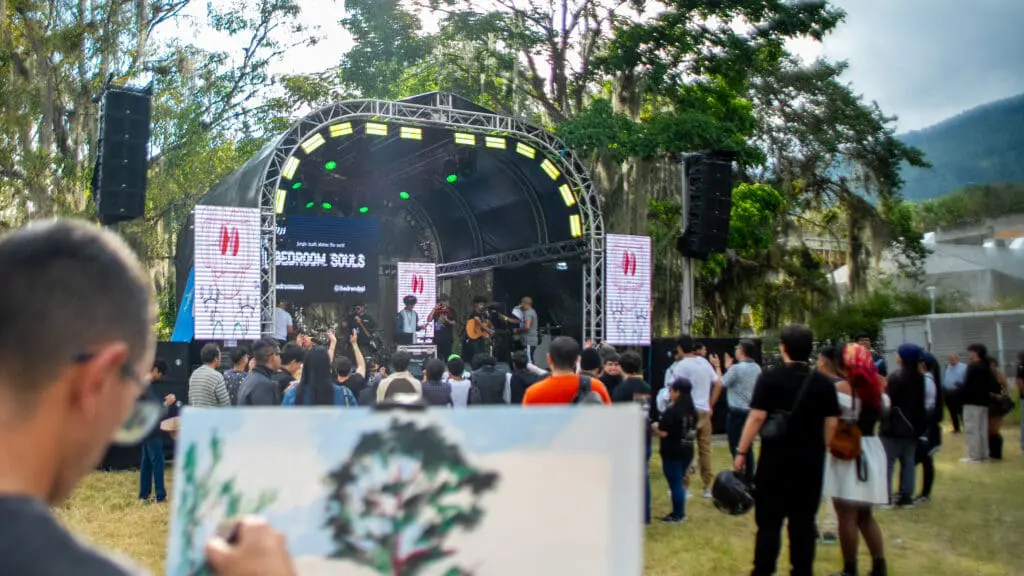
Born in Mérida in 2023 under the motto “Music that sows,” Apamate Fest has grown quickly from a local platform into a regional force for emerging talent, blending live music, art, and environmental activism.
In just two editions, the festival’s scale has expanded significantly. The 2025 edition brought together 27 musical projects from Mérida, El Vigía, Barinas, and San Cristóbal — double the number from its first year — involving more than 100 artists. More than 2,500 people attended in person, with a further 2,300 joining via streaming across 12 hours of continuous programming. Behind the scenes, 40 brands and 65 volunteers made it happen, supported by 20 training activities running from April to December.
Climate action highlights
Planting more than trees
The core of the festival is environmental restoration through reforestation. During the rainy season, five sessions were held in which volunteers, students, and neighbours planted 500 trees of local species — including apamates, jacarandas, bucares, and mahogany — at sites across the region, such as Enlace Vial Germán Briceño Ferrigni (Mérida), Parque La Isla (Mérida), and Aldea La Colorada (Chiguará).
For the organisers, this goes beyond planting trees: “we sow conscience, bonds, and future,” addressing the climate crisis while reconnecting people with their surroundings.
Making every decision count
Audio and energy providers were selected based on energy-efficiency criteria for equipment use. Signage was incorporated to promote responsible waste management, park cleanliness, and a reduction in single-use plastics among attendees and businesses.
A significant achievement was the diverse, high-quality gastronomic offer, featuring local projects that reduced fuel-related consumption, supported local commerce, and provided artisanal, healthy, and traditional options.
This demonstrates that climate action is a shared commitment between the organisation, its providers, and the public.
A commitment beyond the stage
The festival is committed to a circular management model and therefore to the Sustainable Development Goals (SDGs) related to education, reducing inequalities, promoting gender equality, and life on land ecosystems.
For Arnaldo Montilla, the project director, the Cultura Circular programme enabled him to learn that it is possible to produce events in a conscious and responsible way, transforming culture into a real tool for environmental care.
Apamate aims to cultivate a greener, fairer, and more inclusive future for everyone, translating the beauty of art and the act of planting a tree into tangible change.
Spread the word