

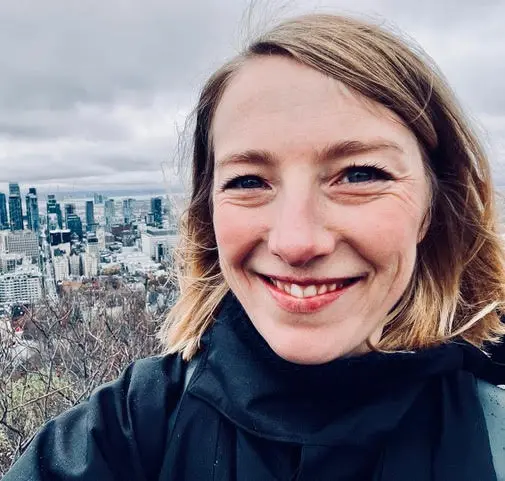
Based in Norway, Gulli Sekse works at the intersection of dramaturgy, strategy, and international collaboration in the performing arts through ReArtica. With over seven years’ experience at Carte Blanche – Norway’s national company for contemporary dance – she has developed strong expertise in touring strategy, artistic development, and international relations. Now working independently with her new practice ReArtica as a dramaturg, curator, and strategic advisor, she supports artists and organisations in shaping projects and building sustainable international practices.
Gulli took part in the Changemakers cohort of ITER 4 (International Touring and Environmental Responsibility Programme 2025–26). She is also a partner in two of the three selected ITER4 projects, Threshold – A New Wild Border Journey, which will explore ultra-slow, low-carbon touring and the ecological and social questions surrounding climate justice in Arctic regions, and Regenerative Business Frameworks in the Arts, by Wildtopia (Denmark); ReArtica (Norway); and Caravan / Farnham Maltings (Distribution Partner – England).
In this piece, Gulli reflects on how touring can be reimagined as a relational and regenerative practice, shaped by dramaturgy, ecological thinking, and reciprocity.
Touring has always been central to the performing arts, carrying art from its place of creation into the world. But what if we saw touring not only as movement or mobility, but as a living practice that connects imagination with the world around us?
I’ve spent over a decade working with touring, dramaturgy and artistic development – the last seven years as Touring Director for Carte Blanche – The Norwegian National Company of Contemporary Dance. Over time, I became curious about how touring could evolve, not only as logistics, but as a meaningful practice. What if touring was understood as an ecology: a system of relationships, rhythms, and exchange?
Having moved between institutional and independent contexts, I’ve witnessed two complementary touring realities. Institutions are rich in resources: they offer reach, stability, and visibility. At the same time, they are steady systems, shaped by mandates, structures, and schedules that can make flexibility and experimentation more complex. Touring within these frameworks often follows established patterns, and transformation tends to happen gradually.
In the independent field, resources are fewer, but there’s greater freedom to experiment – to start from values, relationships, and intentions rather than systems. Each project can find its own shape, opening possibilities to think ecologically and socially from the very beginning: to ask why we travel, how we engage, and what each encounter leaves behind.
Having lived within both structures, I’ve become interested in how their strengths might inform one another: How the independence and adaptability of the freelance field might inspire institutions, and how institutional infrastructure might support longer-term, relational touring in the independent scene.
Across the performing arts, there’s already movement in this direction. Artists and organisations are experimenting with slower touring models, longer stays, and sustained collaborations that connect more deeply with local contexts. Performances are accompanied by workshops, conversations, and projects that invite audiences and communities into the artistic process. Touring becomes less about presentation and more about exchange: a living ecosystem of learning, connection, and renewal.
Even as the field moves toward more sustainable models, the question keeps returning: if we care about impact, should we be touring at all?
It’s a fair question, but stopping altogether would mean giving up something vital. Touring enables artistic exchange between artists and audiences, between cultures, disciplines, and communities. It sparks dialogue, nurtures imagination, and keeps art present in civic life. Touring is a form of cultural diplomacy: a way of connecting across borders and differences, fostering empathy, curiosity, and collective imagination.
Rather than stopping touring, we need to reimagine it as a practice that sustains both art and the world around it. It’s not only about showing work, but about how art moves through the world and how that movement creates meaning.
Seeing Through a Nature Lens
One way of reimagining touring is through what I call a Nature Lens. In nature, everything is connected: cycles, rhythms, interdependence. What if touring worked the same way?
Every decision – how we travel, how long we stay, who we collaborate with – becomes part of a larger ecology. Touring is never isolated, it’s entangled with its surroundings: artistic, social, environmental, and human. Through this lens, touring becomes less about circulation and more about cultivation – a process of dialogue, reciprocity, and context.
A Nature Lens invites simple but important questions:
- How can a tour leave positive traces?
- How can artists and audiences engage locally and contextually?
- How can our choices support regenerative rather than extractive patterns?
For me, a Nature Lens brings imagination and action together, inviting us to see movement itself as a creative and relational force.
Shaping Through Dramaturgy
If the Nature Lens offers a way of seeing, a dramaturgical approach offers a way of shaping. At its core, dramaturgy is about relationships – between ideas, forms, and contexts. Applied to touring, it means approaching the process dramaturgically: from the first artistic impulse to how the work resonates in each new place.
Every decision – routes, partners, pacing, formats – becomes part of the project’s narrative. It’s about using artistic tools to shape the structure itself, composing time, rhythm, relationships, and context with the same care we bring to the stage. This creates coherence between artistic intention and structure, allowing the tour and the artwork to evolve in dialogue.
A dramaturgical approach turns touring into an ecosystem of meaning and connection, linking artistic, human, and organisational layers. The tour becomes an extension of the artwork’s dramaturgy: a living structure shaping how art moves through the world, and how it connects to the societies it meets.
Towards Regenerative Touring
Looking ahead, I believe touring can evolve into a regenerative, relational practice – connecting art, ecology, and society. When done with awareness, touring becomes a form of social infrastructure: building empathy, curiosity, and shared understanding across borders. It keeps art visible in civic life, offering space for imagination, reflection, and freedom of thought.
By integrating dramaturgy, ecological awareness, and reciprocity, we can create touring models that generate value rather than depletion – models that sustain both art and those who make it. The changes ahead should not be seen as obstacles, but as openings: invitations to think differently, to collaborate across disciplines and borders, and to imagine new ways of creating, moving, sharing, and coexisting. Touring remains vital – not only as a vehicle for performances, but as a space for cultural exchange, collective imagination, and human connection.

Spread the word