


For Arts Council England and Julie’s Bicycle’s Annual Report 2024-25, we feature over 70 practical examples of cultural organisations taking climate action including in depth case studies like this one. Check out the full interactive report.
Disability Arts Online (DAO) is a UK-based charitable arts organisation led by disabled people. Their mission is to champion and nurture disability arts and culture. DAO serve artists and arts audiences who face disabling barriers and, in doing so, enable social change. DAO’s website showcases disability arts content, artist development programmes, partnership and consultancy work, accessible events and a vibrant community of disabled creatives.
DAO’s Approach to Environmental Responsibility
There’s been a significant shift in how we address environmental responsibility at the organisation since we started thinking about its alignment with our core organisational values. Disability is often left out of the conversation about climate justice, so bringing disability justice to the centre of our environmental action was vital. Environmental responsibility is now a core part of our strategy, strengthening our work and building trust with funders and the community. We are keen to hear from disabled creatives and other disabled-led organisations about their approach so we can learn from each other. We also urge the rest of the sector to consider disability and access as integral to their own environmental commitments.
Trish Wheatley, CEO, Disability Arts Online
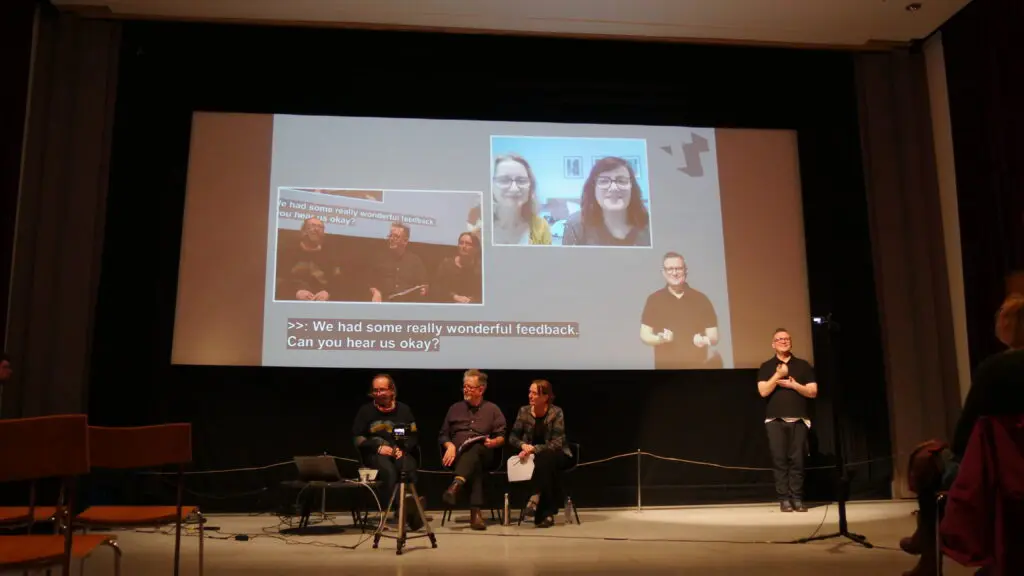
A small and fully remote team, they deliver the majority of their work through digital and hybrid events, with some work carried out in-situ with place-based partners. Although their carbon footprint is small, DAO committed to monitor and reduce their digital impact, recognising that digital does not automatically mean green.
We recognise the urgency of the climate crisis. We know disability is an intersectional experience, and it’s clear that the impact of the climate crisis disproportionately impacts disabled people, those from the global majority, and those who are economically precarious. We think that disability justice and climate justice go hand in hand.
DAO’s environmental approach rests on two principles: environmental justice and balancing stakeholder access with sustainability. They have found that access requirements are often in direct conflict with low environmental impact solutions. For example, taxis are regularly necessary instead of public transport and single use plastics are needed for others. As an organisation that follows the social model, they believe that responsibility for this should not sit with the individual who has access needs and instead they try to minimise impact at an organisational level.
To embed sustainability internally, DAO have had staff and Board Environmental Champions in place for several years. More recently their focus is on bringing environmental considerations into all planning stages of their activities. With this and their other commitments, they are confident they will be net zero by the end of this financial year.

Developing New Embedded Systems for Understanding and Acting on Carbon Emissions
Recognising that travel and accommodation were two of the most significant contributors to their footprint, DAO recently implemented a new system for monitoring emissions in these impact areas.
DAO staff engaged in the development process from the very outset, helping to identify potential barriers and refine the system so that the system remained as accessible and intuitive as possible.
Before asking staff to choose the ‘greener’ option, they created prompts that encourage them to reflect on their access requirements and what they need to travel safely. This approach supports environmentally responsible choices while minimising the barriers experienced.
They have embedded the new process within their expense claim system, making carbon monitoring part of the standard workflow rather than an additional task. When booking or claiming travel and accommodation, staff enter journey or stay details, including distance travelled, mode of transport, and type of accommodation, directly into a custom-designed form. They store this data in a centralised system, where a dedicated team member reviews submissions, resolves any gaps or inconsistencies, and prepares the dataset for analysis and submission to Julie’s Bicycle.
The new system has had a tangible impact on how DAO plan and deliver their work. Having easier and more regular access to up-to-date data means they can now make informed choices about travel and accommodation at the early stages of planning. It enables the team to predict the likely environmental impact of specific projects and activities before they take place, allowing them to explore lower-carbon alternatives where possible.The data has also helped them to identify situations where access requirements may conflict with environmental goals, allowing them to plan in ways that prioritise access requirements while minimising environmental impact.This insight has guided the development of their new project plan template, ensuring that environmental considerations are embedded into the decision-making process.
Over time, the system will help DAO to identify year-on-year patterns in travel and activity, moving away from arbitrary reduction targets toward evidence-based monitoring and adjustment. This means understanding the reasons behind changes in their footprint and making more targeted interventions.
Accounting for Carbon
DAO are integrating carbon offsetting directly into their core budget so that the environmental impact of their operations, including our website, business travel, and homeworking, are accounted for. To set their internal carbon price, they researched best-practice approaches, drawing on insights from industry resources such as the Julie’s Bicycle webinar Putting a Price on Carbon and its accompanying briefing report. DAO set an internal carbon price high enough to drive change, but realistic for their budget, creating a ring-fenced resource for climate action.
The value of our carbon budget lies not only in the price we set, but in how we channel it towards addressing the climate crisis. We are mindful of emerging research on net zero pathways, which shows that the burden of offsetting often falls disproportionately on marginalised groups. This awareness shapes our commitment to ensure that our climate action is firmly rooted in justice.
DAO recognises that offsets cannot fully “undo” emissions on a strict tonne-for-tonne basis. Therefore they treat them as one element of a broader climate strategy – complementing, but never replacing, other efforts to reduce emissions. For this reason, the majority of their carbon budget is directed to projects and charities driving environmental change and climate justice through advocacy, conservation, education, research, and legal reform. In doing so, DAO aim to place their values at the heart of our approach, funding initiatives that advance both climate and disability justice and support meaningful, systemic change that resonates with audiences, staff, and partners.
Striking a Balance
Our strategy enables us to contribute both to measurable emissions reductions and to transformative work that is harder to quantify but equally critical to addressing the climate crisis.
DAO have found including carbon in their budget both a challenge and an opportunity. The challenge comes from setting a carbon price that truly reflects the social and environmental cost of emissions while also balancing the reality of limited funds and other operational demands. With resources stretched across programme delivery, staff, access, wellbeing, and organisational resilience, sustaining a meaningful carbon budget calls for deliberate decision making, long-term commitment, and a shared culture of responsibility across the organisation – even when short-term pressures compete.
At the same time, this approach has become a real catalyst for change. By embedding carbon into financial planning, environmental impact is considered from the outset of every project. This shapes decisions about scope, design, and delivery, encouraging DAO to think differently about the way they work, choosing lower-carbon materials, reducing unnecessary travel, and rethinking how technology connects people and resources.
Making carbon part of the budget has also strengthened collaboration and accountability across the organisation. Staff and board members are directly involved in deciding which initiatives receive funding, ensuring a sense of engagement and ownership. A part of their budget is dedicated to help each staff member develop an individual carbon-reduction plan for remote working. Both of these initiatives are currently being piloted, providing valuable insights that will guide future improvements and processes.
Balancing competing priorities is never straightforward, but by integrating carbon in our budget, we make sure environmental responsibility isn’t an ‘add-on’. Instead, it becomes part of how we deliver our mission more effectively, strengthen trust with our community, and demonstrate leadership in tackling the climate crisis.
Images: Header: Lead artist, Aidan Moesby on a research visit in Harstad, Norway as part of Climate
for (Ex)change | Image 2: Revell Dixon (left), DAO’s Associate Artist, and Deen Hallissey (right) recording a piece of digital content. | Image 3: In conversation with Birds of Paradise Theatre as part of the hybrid event ‘Explorations on a Telepresence Stage’ at DaDaFest 2025.
Spread the word