
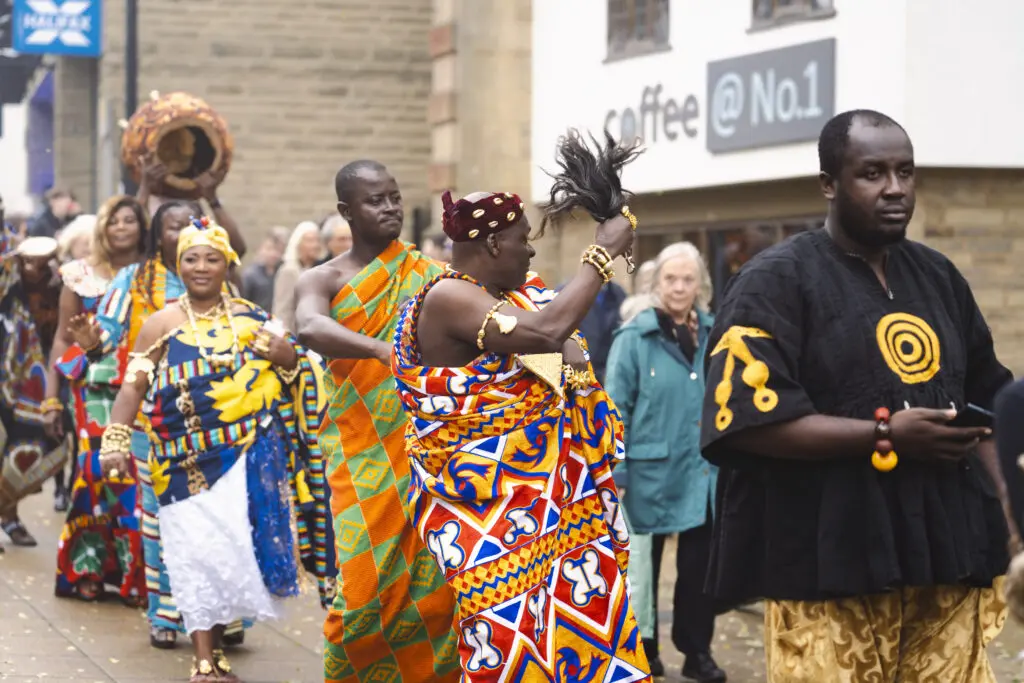

voice from the movement
For 2025-26’s Arts Council England’s annual environmental report, Adelle A’asante is our Voice from the Movement. Read on for her reflection…
They say a woman can only be as true as her mother tongue. So sometimes, when we meet
like this, allow me to say:
“Sε w’ankasa wo tirii ho a, yε yi wo ayi bᴐne.”
This also means:
“If you do not tell your story, be sure someone else will and they might not tell it right.”
These are the profound words of my grandmother, Akosua Otenewa Onyamaka, a West African
griot and Kokoo farmer.
For four generations and counting, women in my family have been tilling and toiling the soil as
Kokoo farmers in a village called Sehwi Akyease, somewhere in Ghana, West Africa; my home
country.
Many, many, many miles away from the United Kingdom, a chocoholic nation where chocolate
becomes the expressive language of love, affection, and grief.
And it is in honour of my grandmother, and the many foremothers before her, that I continue to
practise the sacred and fine art of storytelling, but perhaps in very difficult and challenging times.
Times when our planet bears the cataclysmic weight of the climate crisis.
Times when those who have contributed the least to the crisis are asked to carry the heaviest
burden. Times when knowledge once dismissed by institutions is being rediscovered by those same
institutions.
In these times, chocolate, for us, ceases to be a product. It becomes a site of memory. Hbportal
into climate, colonialism, language, power, and, ultimately, repair—because Chocolate Has a
Name.
Chocolate Has a Name is a reparative movement using Kokoo and chocolate as sites of
memory. Our journey began amid urgent conversations about Kokoo sustainability. These were
conversations about supply-chain resilience and many certification programmes. The
interventions were often good, but the people with lived experience were rarely at the core of
these conversations: promises were made without transformation, consultations without power,
and sustainability plans without justice.
Too often, lived experience was invited into the room only after decisions had already been
reached. Lived experience appeared in those spaces merely as testimonies, quotations, case
studies, and, quite often, emotional appendices. But lived experience is not decoration. It is not evidence borrowed to support conclusions reached elsewhere.
No. Lived experience itself is a rigorous and radical way of knowing.
It is a radical knowledge-building and knowledge-sharing practice. It carries forms of knowledge
that cannot always be measured by data. It remembers what institutions have forgotten. It
notices what systems have trained themselves not to see.
It preserves relationships that statistics alone cannot describe. And, perhaps most importantly, it
asks the questions institutions often find most uncomfortable.
Questions like: Whose knowledge is recognised? Whose expertise is trusted? Whose authority
is permitted to count?
These are not just questions about inclusion. No. These are questions about justice, because
every system of exclusion begins by deciding whose knowledge matters, and every act of repair
begins by recognising that wisdom has never belonged exclusively to institutions. Sometimes, it sits quietly in communities.
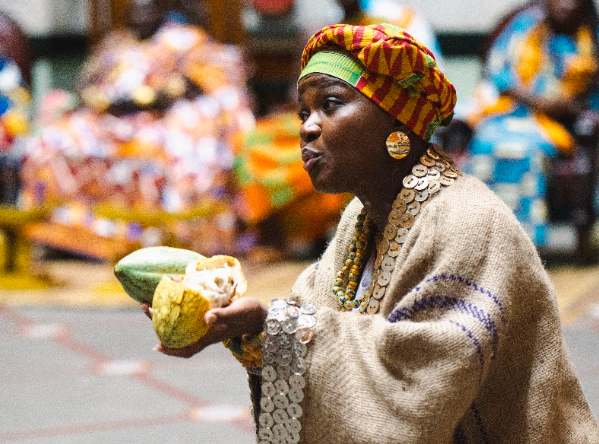
Chocolate Has a Name emerged from this disrepair as an intentional act of reparations.
Reparations as understood within Indigenous knowledge systems. Quite simply: to repair.
To raise up that which is ingrained. To restore. To raise up that which is ruined. To restore that
which has been damaged. To rejoin that which has been unjustly separated. To replenish that
which has been depleted. To strengthen that which has been weakened. To set right that which
is wrong.
And to make flourish that which has been denied the conditions to flourish.
Reparation, really, is not pity. It’s not an act of benevolence. Neither are they a temporary
response to historical guilt.
Repair is the restoration of relationships: the relationship between people and land; between the
farmer and the value created from their labour; between children and the futures they are
entitled to imagine; between language and dignity; between knowledge and the communities
that have carried it across generations; between humanity and the Earth that continues to
sustain us.
Repair understands that colonialism did not merely extract resources. It extracted stories,
names, authority, language, memory, and imagination. It extracted value from labour while
separating labour from value. It separated cultivation from consumption, production from
transformation, communities from opportunity, and people from power.
Today, approximately 70 per cent of the entire planet’s Kokoo beans are sourced from just fourcountries in West Africa: Ghana, Ivory Coast, Nigeria, and Cameroon. Yet, in these places, Kokoo rarely forms a meaningful part of everyday eating culture.
How can a people cultivate a crop for generations and remain strangers to its full journey? How
can the farmer carry the risk while somebody else inherits the value?
This is neither accidental nor incidental. It is deeply historical and structural.
The colony produced.
The Empire processed.
The colony laboured.
The Empire profited.
The consumer encountered chocolate without ever encountering the farmer. The story of
chocolate began at the wrong end: with the sweetness, not the soil.
nd so we returned. We returned to the source, where a Kokoo farmer’s child asked us, “What
happens to our bean when it leaves our farm?” This simple question was really a question about power. Why should that child grow up knowing everything about cultivation but nothing about value addition?
Our response was quite ambitious: to introduce local processing and value addition into the
everyday learning experiences of children growing up in Kokoo-farming community schools.
This goes beyond teaching the child how chocolate is made. This is about repair.
Repair to imagination.
To restore knowledge sovereignty, land sovereignty, and seed sovereignty. To give the Kokoo
farmer’s child permission to imagine beyond growing the crop—to owning the story.
This is the work Chocolate Has a Name does.
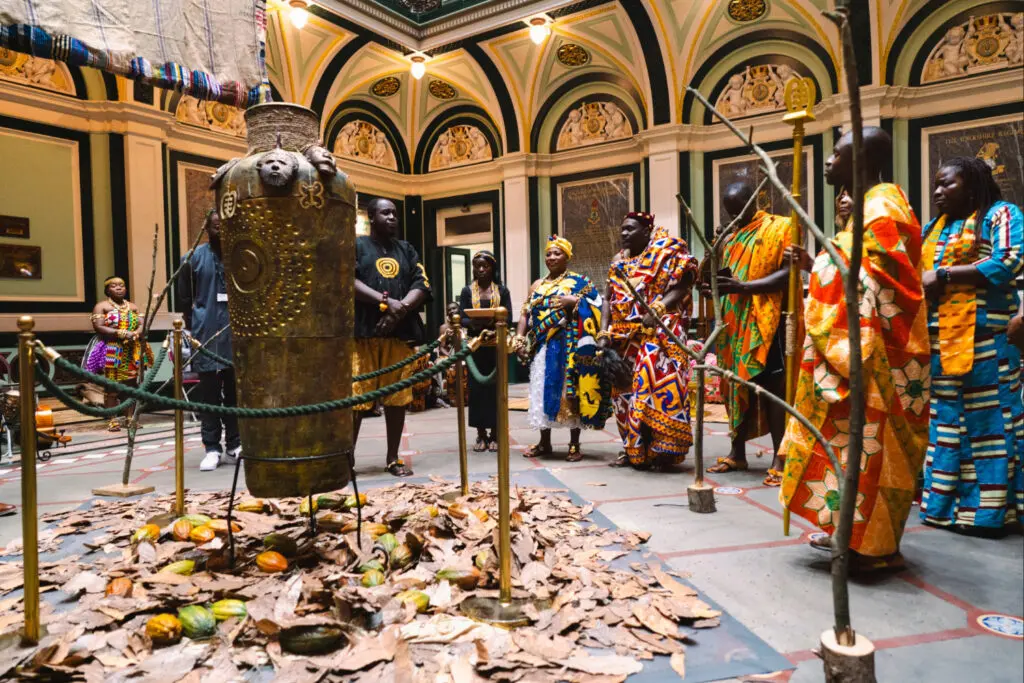
We connect the worlds of chocolate cultivators and consumers through the sacred and fine art
of storytelling; through festivals, public installations, workshops, community learning spaces,
reflection, and reparative action.
Because our work is very much intersectional, language sits at the fulcrum of this work.
As a child, I remember going to school and being told, “Do not speak vernacular. Speak English.
Speak the language of progress.”
Today, the world celebrates vernacular architecture as sustainable, intelligent, and responsive to
place. But to rediscover knowledge without naming the people who carried it is still extraction.
So we name.
We name the places, the spaces, and the faces. Because a place without a name becomes a
site of extraction. A farmer without a name becomes labour. Chocolate without a name becomes
a commodity without memory.
And as we began speaking about Kokoo, we found that we could never do so without speaking
about migration.
As the climate crisis intensifies, people are forced to move. They move because home can no
longer sustain them. Yet, when they arrive, nobody arrives empty-handed. People carry
languages, recipes, memories, professional identities, stories, and entire knowledge systems.
What is lost is not the knowledge.
It is the authority for that knowledge to be recognised.
So there is no climate justice without repair.
For years, systems have asked communities: How will you survive with less? What is your
sustainability plan?
But communities have always sustained life. They have sustained families, languages, cultures,
harvests, memory, and hope.
Perhaps it is now time for communities to ask systems a different question:
What is your reparative plan?
What will you return?
What will you restore?
Whose authority will you respect?
What power will you relinquish?
What relationship will you repair?
And what guarantees will you offer that the harms will not be repeated?
Because the story of chocolate must no longer begin at the point of consumption.
It must begin with the soil, the farmer, the child, the community, the language, the knowledge,
and the names.
Names like Sehwi Akyease, Sehwi Anwiam, Sehwi Bekwae, Tepa, Kyekyewere, Tarkwa, and
Braman. Names like Nana Nyanteng, Maame Boadua, Raymond Atanga, Akosua Otenewa Onyamaka,
Aqua Dansoa, and Sekyibea.
The places, the spaces, and the faces.
Who ask these two important questions:
What are the cultures that have shaped the world we now know and see?
And, as we write the next pages and chapters, what are the guarantees of non-repetition?
We ask this because, quite simply, when people and their stories are forgotten, their humanity is
lost.
So, you will remember me as Mansa, the Kokoo and chocolate reparationist.
Quite simply, I am here to repair.
Because Chocolate Has a Name.
Spread the word