
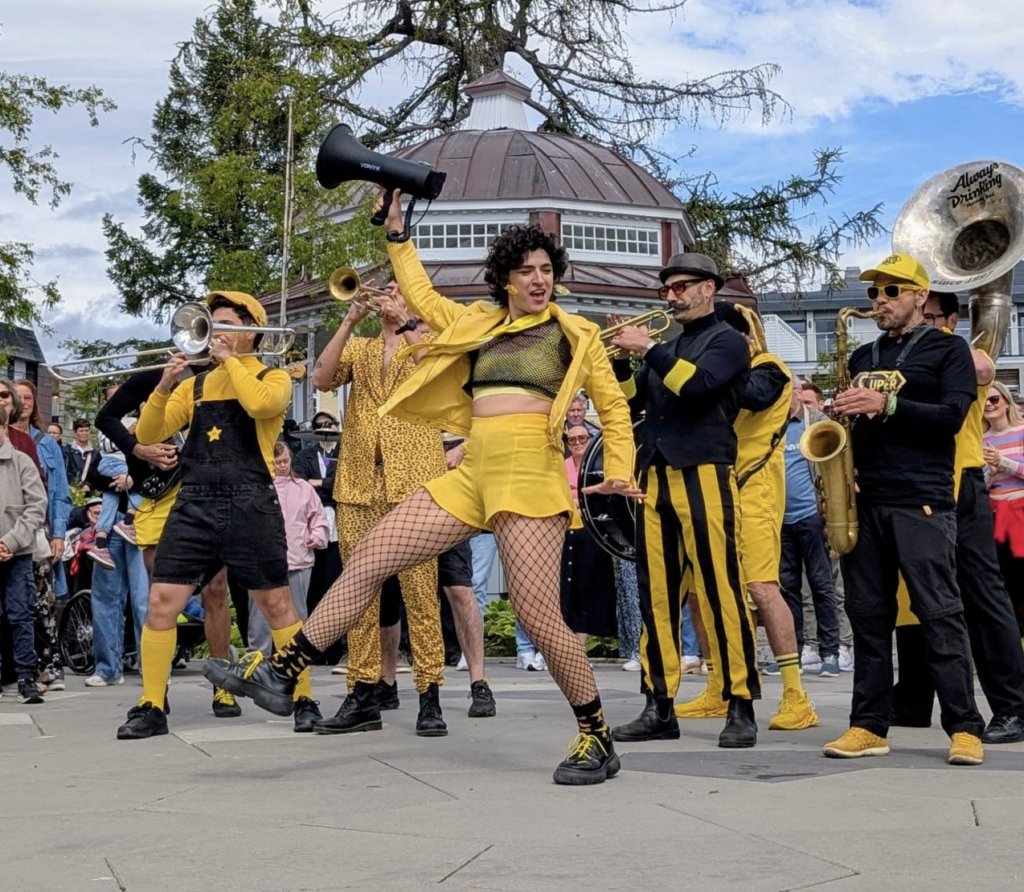

– Written by Hannah Graham, JB Arts and Culture Programmes Lead
It will take a paradigm shift – a whole ecosystem change – to support the possibilities for touring arts in the Arctic regions.
But who is actually taking part in these conversations? Who is missing from them? And what happens when artists and creative organisations are asked to reckon with what sustainable touring really means here? JB Arts and Culture Programmes Lead Hannah shares her reflections from Festpillene I Norde-Norge, The True Northern Arts festival in Harstad, Norway.
I have just spent four days at Festpillene I Norde-Norge, The True Northern Arts festival in Harstad, Norway. Together with our Danish partners, In futurum, we attended the festival to run a session about sustainable touring as part of the parallel-running industry programme.
One intention for the workshop was to hear from artists who took part in the previous iterations of our International Touring Environmental Responsibility programmes, ITER 3 and ITER 4, while sharing practices and knowledge.
Because of its proximity to the region, Danish partners In futurum suggested making this an open space for exploring the needs and barriers around touring both in Norway, and across the wider Arctic region. With ITER 5 now open for submissions from artists across Norway, Denmark, England and Scotland, this was our chance to further develop our understanding and adapt our training to these locations, especially Nordic countries and their rural landscapes.
Before the workshop, I spent two days soaking up the festival atmosphere and spending time with some of the artists who are developing their ITER-funded projects. I met up with Beatrice Gijón, a multidisciplinary artist and composer, and Evangelos Kosmidis, a theatre director, writer and actor, leading on the Green Folkways Exchange.
I shared what our session on sustainable touring would cover and the initial response was often similar: an assumption that this mostly relates to avoiding air travel, sometimes said with a kind of weariness, like the whole thing was already a lost cause.
The Green Folkways Exchange is a digital research archive and visual map about nature-based folk stories from 10 different countries, which mostly tours digitally, country to country, becoming inspiration for creative responses without artists ever having to travel. I also met with Maiken Garder from Elle Sofe Company and Prokhor Gusev from ISKRA Production, both previous ITER participants who were speaking at the workshop.
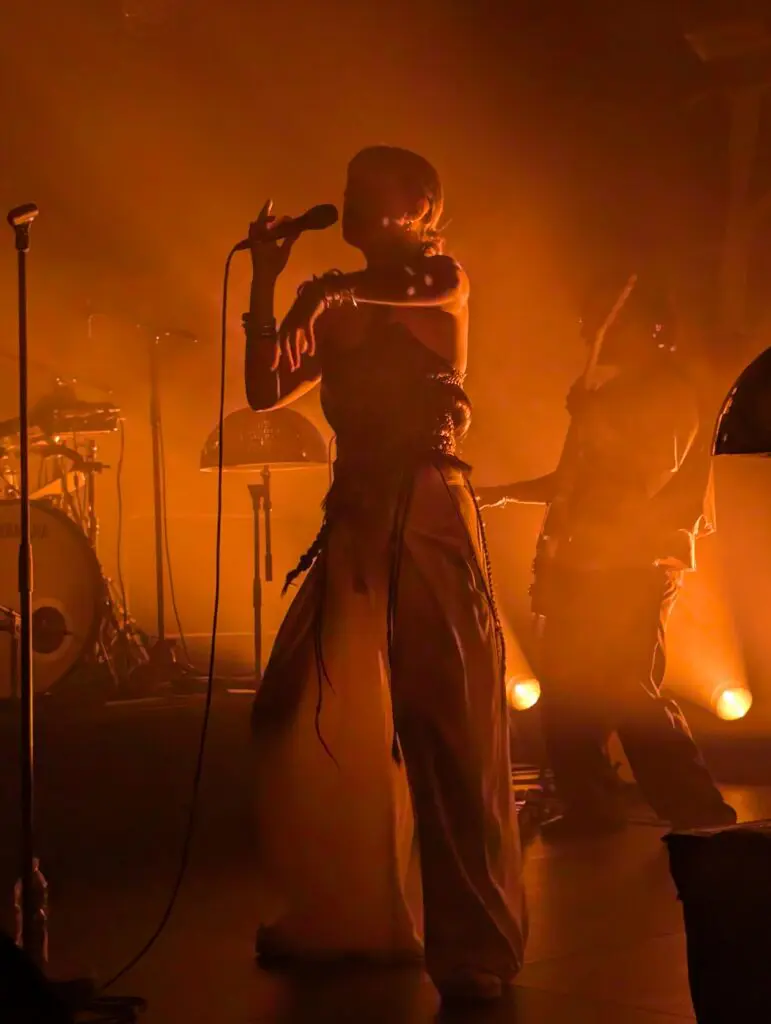
I caught the festival opening and was lucky enough to have an artist pass to flash, gaining me entry into some incredible events. Some standouts for me were Katarina Barruk, an absolute powerhouse Sámi singer of traditional yoik music from Northern Sweden. I also loved Cavalcade en Cocasie, featuring multi-instrumentalist Frédéric Jouhannet and his notebook of his imaginary travels that pulled the whole audience into a surreal musical expedition!
Alongside this, I saw Bloodklub, a powerful reckoning on what we believe and how this is shaped by family that is part-theatre, part-ritual and is staged in a church.
The following three days, I met other delegates – producers, writers, musicians and festival programmers. I shared what our session on sustainable touring would cover and the initial response was often similar: an assumption that this mostly relates to avoiding air travel, sometimes said with a kind of weariness, like the whole thing was already a lost cause.
Now, I can share what I’ve learned that means.
Beyond carbon: how local contexts shape sustainability
Simply put, in the Nordic region, travelling without flying is profoundly difficult, and even then it’s not straightforward to measure.
Mindful of this knowledge, In futurum and I set out our key message: that to call yourself sustainable, you do not have to go entirely flight-free, and if you have to fly a company out to a remote island in the North, you have not failed.
Being in Norway is a relatively new experience for me, but from day one I learned quickly that while transport here can be timely and convenient, weather events can cause delays or changes that can quickly set you back hours on a train or bus-reliant journey. Flights are often cancelled.
In the very Northern parts and in the islands of Lofoten, climate change and rising temperatures are significantly affecting both the eco-system and the local people, changing the landscape to something previously unseen, placing the mountains surrounding the fjords under immense pressure. It’s also impacting snowfall, which is critical enough to warrant the Sámi language having 200+ words for it.
Natural lichen growth has been stunted, forcing the reindeer who eat them to search elsewhere, significantly impacting the indigenous communities who hunt them for food. Climate change isn’t abstract here at all, it’s felt – so any conversation about sustainability has to hold that reality.
For artists, there are other realities that shape what sustainability is possible too.
In ITER, we understand that carbon is present in every aspect of our lives, from production to travel to audiences, yet we intentionally avoid getting stuck on this alone. The conversation has to be a holistic one, one of understanding, collaboration, knowledge-sharing, and finding new models and ways of working together.
Over four years, the conversation within ITER has moved from simply “sustainable” to becoming regenerative.
This is the point about the ecosystem approach: bringing artists, venues, festivals and organisations together through the ITER course training. It’s also about the power of being part of an international network where this conversation sits centre stage, where systems can be understood well enough to be questioned and challenged. It’s a long game.
Over four years, the conversation within ITER has moved from simply “sustainable” to becoming regenerative, leading to conceptual innovation in how touring itself is imagined, deeper and longer collaboration with communities, and regenerative business models now being piloted in practice.
For sustainable touring to work here, the room agreed that funders, venues and policy makers need to do more collectively by demonstrating their own commitment to regenerative and sustainable practice, while building the conditions that support artists and organisations to do the same.
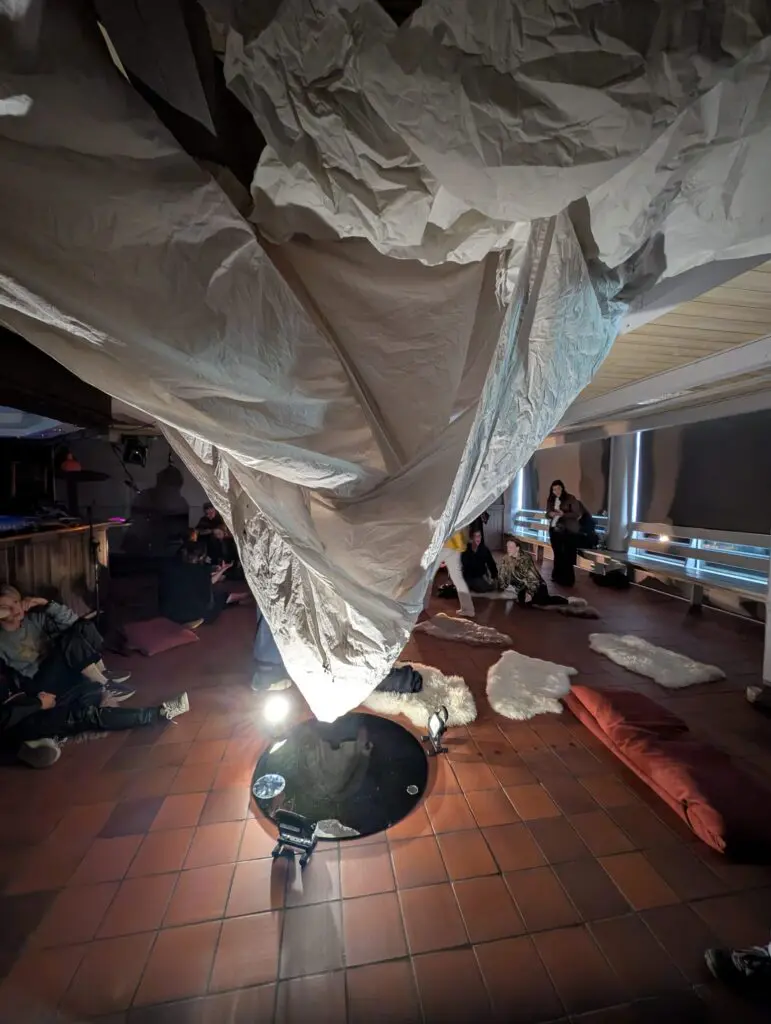
Freelancers and environmental sustainability
Freelancers feel they often carry the lion’s share of the financial, practical and emotional load of being environmentally sustainable. Creatives in the room, as in many other spaces where these conversations take place, call upon cultural institutions especially to step up and meet the artists halfway or more, or further, by lending a hand and a more accessible framework that treats environmental responsibility as a necessity, rather than a tick box.
Prokhor Gusev, who took part in ITER 4, expressed that freelance artists are sustainable because they have to be out of either ethical or practical need, not because anyone is paying them for it. That raises a real question about funding structures built from the perspective of big city councils and whether they have enough insight into the realities up North.
At best, that gap limits how far artists can take their sustainability ambitions. At worst, it leaves them out of pocket, as Maiken explained. This happens when creatives are covering costs that can’t be claimed, like customs paperwork to cross into the very regions the stories they’re carrying originally came from, without always being able to reach those places effectively, or for long enough.
In futurum’s Moussa Mchangama hosted the morning’s conversations and presentations, and asked a pertinent question: how might a creatives’ artistic practice change if liberated from pressures like immense paperwork, producing tours on impossible budgets, and carrying the sustainability burden alone, affect their artistic practice?
Creating that joy means genuinely valuing the artists and their work and doing more to bring audiences to visiting shows, not just the ones produced in-house.
The question quickly became: how does that liberation happen and who supports it? Ultimately, while venues want to book artists here in Norway, the feeling is that they’re not active enough in these conversations. Neither are the venues transparent enough about their own commitments, policies and action plans on both environmental sustainability, and on making touring possible and enjoyable for the creatives doing it. Because it should be a joy to tour!
Creating that joy means genuinely valuing the artists and their work and doing more to bring audiences to visiting shows, not just the ones produced in-house. New work is usually a painstaking labour of love, mentally and physically demanding from first idea to last performance. Venues carry that work for a few nights.
Listening to these reflections, I wrote a question in my book: what would it look like if venues and festivals saw themselves as temporary custodians of something precious and vital, rather than another stop on a schedule?
“There’s a power imbalance here and it isn’t being addressed”
Later on, I thought about green riders that are popping up in the UK venues and I wonder how green riders on both sides could become a conversation instead of a demand – more of a way of working out what’s fair, what’s ethical and what’s actually possible. This could be a conversation of reciprocity, to each other and to the planet, and was a theme that came up in the room later.
As one attendee put it: creatives want to see venues with state funding and public responsibility do better and be honest about it. Share the actions taken, fail, then fail better, and tell that story too. Audiences already assume venues are doing this work.
In the UK, venues tell me they’re stretched thin on staff, resources and budget. I don’t doubt Norway and Denmark experience the same. So where’s the middle ground? Would more honest, upfront conversations between producers and creatives build the trust that’s missing to accelerate this work as a collective, accountable endeavour?
But then, can contracted creatives ever share their real cost of touring, without eating the loss on unpaid travel days themselves? There’s a power imbalance here and it isn’t being addressed.
It can’t be fully understood until those in power represent those making the work.
A Sámi writer in the audience spoke about the vital need for representation. She mentioned how, for the first time in history, two Sámi-speaking members now sit on the Norwegian Cultural Council, alongside several others from the North. This means that in a room where decisions are made and where money is distributed, Sámi people and those who understand the context of the North finally have power to advocate for those creatives, their work and their unique practice, which is so closely tied to the land.
“I couldn’t write what I am writing if I didn’t live where I live because the land is guiding me to the writing […] the place where you live and work will decide what is important to you and I believe that representation on all kinds of deciding boards is so important.”
An actor in the room later proposed a call to action. He spoke about the need for politicians to hear and be moved by these experiences, and for further support, representation, accountability and investment to follow that.
He raised the idea of freelancers across the North coming together on a piece of advocacy. It got me thinking about the ITER network, (which we’re setting up this year) and whether it should open beyond the alumni to the wider collaborators in these creative circles too. Advocacy like this only works with a shared goal, real organisation, and a collective will for change.
Responding collectively to needs and barriers
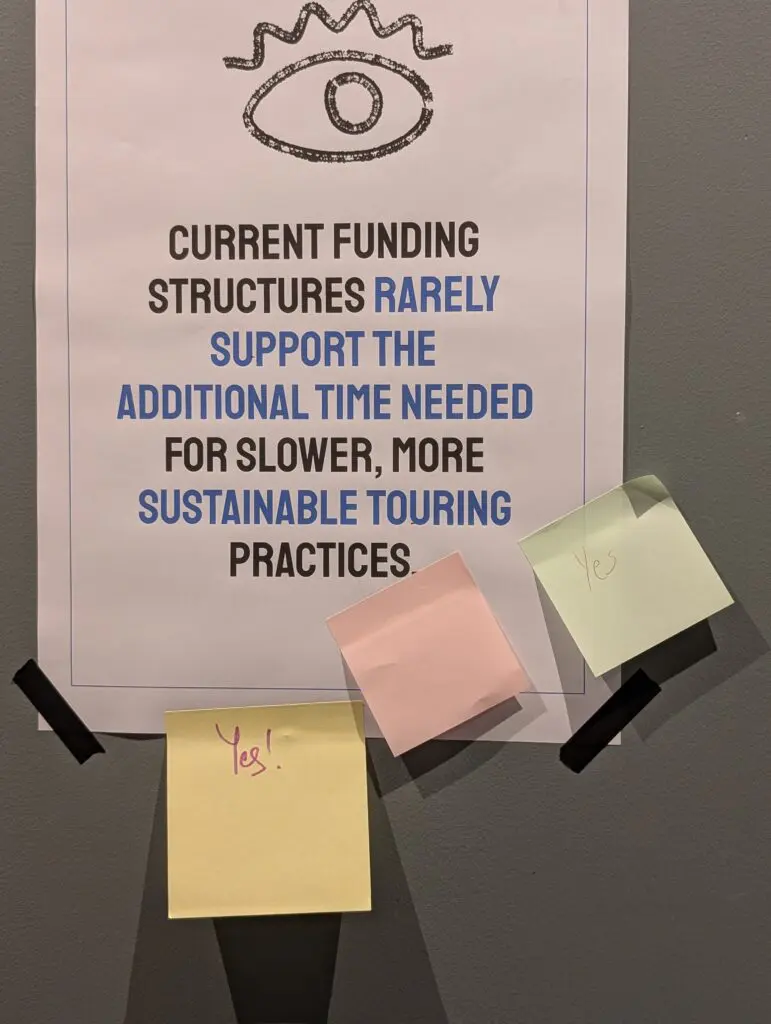
Outside of the room, in the gathering area, people were asked to respond to posters on the walls. In futurum had arranged some statements to be put up on posters, derived from conversations with the festival staff themselves and creatives. The blue posters were statements about barriers and the green posters were about needs.
Those in the room were invited to wander out there and add their own thoughts to these statements, either simply to agree with statements that resonated or to add further context or thought to them. They were also invited to make their own statements. Here are three that stayed with me.
In small groups, we discussed practices and processes that could support more sustainable touring. In my group, reciprocity was the central theme. Keeping traditional stories alive, telling them to the world and back to the communities they came from, felt like an act of reciprocity in itself. It’s how we’re taught to ‘be’ within a place, to treat culture as the foundation of how we relate to the earth and therefore how we care for it (and each other).
I noticed when I sat with the questions about sustainability, my group kept returning to process over product, the idea of making art in a way that feels healing, liberated and joyful matters as much, if not more, than the finished piece reported to funders. There was a sense that something here is intangible, still not fully understood in its depth and breadth of impact.
Impact that happens in a room where the venues, funders and politicians aren’t present. For example, when something meaningful and full of hope about the future lands within an ensemble. When a traditional craft passes from an elder to a young person in the making of an exhibition. When a song as old as the mountains it came from is sung back to a community, as hands sow seeds into soil around a fire.
The impact of culture, so often tied to language and heritage, is then reborn in front of every new audience and often impossible to measure in the years that follow. It’s often months or years later that people trace back a single show or experience that changed their heart, their mind, or moved them to make a change in their life.
This way of engaging with one another, of being carried into another world through song, dance, performance, ritual and care is the marrow in the bones of culture. When it comes to climate justice, that same transformational power sits at the core.
As Prokhor Gusev put it: “We are living in a world where money rules, we have to talk more about the influence and the product of culture…art is basically the social glue.
The whole ecosystem needs to remember that and to return to valuing the transformational power of culture and the people who bring it to life for audiences. This got me thinking: how can sustainability become regenerative if the system supporting cultural makers can’t yet sustain the art itself, or the practice of being an artist?
If we’re going to imagine, rehearse and build better futures, then culture and creative practice need to be better resourced, supported, and given room to collaborate in models that are regenerative to them. Only then can they truly show us what’s possible, as we move through a changing and uncertain climate.
As Prokhor Gusev put it: “We are living in a world where money rules, we have to talk more about the influence and the product of culture…art is basically the social glue. If we do not have this exchange, where we are together, there would be no communities, there would be no countries, like nothing that really connects us. So politicians should really be aware of what we are doing…this really will change the future…Oil will not save the soul.”
To watch the full event with speakers and find out more about the Green Folkways project (which I have run out of space to talk about!), or read more and apply for ITER, follow the links below.
ITER is initiated and financed by Arts Council England, Arts Council Norway, Creative Scotland, and Danish Arts Foundation, and designed and delivered by Julie’s Bicycle and In futurum.
Spread the word