

What are the environmental impacts of AI, and what impact will this have on the art and cultural sector?
Written by Imogen Cripps
This blog is the second of a series of pieces from JB on the topic of AI and its use in the creative industries. We will be exploring the environmental and ethical concerns arising from the use of this technology, how the sector is responding to these challenges, and what the future of AI in the arts might look like. This piece focuses on the ethical considerations of AI use.
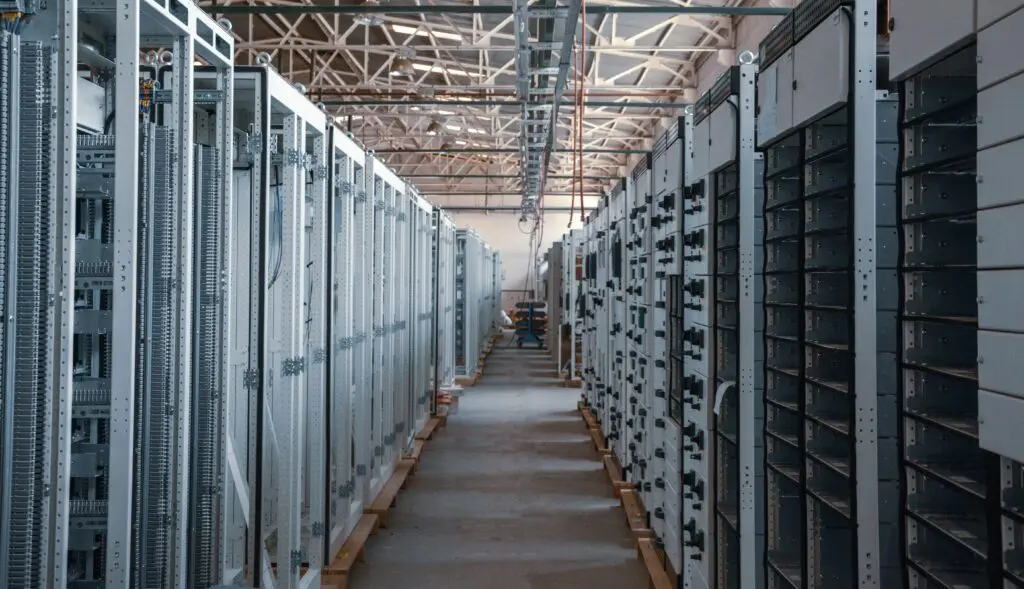
When you think of the cloud, what comes to mind? Perhaps something weightless and distant? Or an untouchable entity that drifts past without leaving a mark? You may not think of a network of vast physical infrastructure: data centres running around the clock, drawing on enormous quantities of water and electricity.
This points to a major rift in how we understand materiality in a digital world. How much do we really acknowledge the impact that our online lives have on the physical world? The words we use to describe the online realm no doubt support this – it’s hard to grasp something tangible when we’re talking about the network or an algorithm or the world wide web.
As arts and cultural communities increasingly integrate artificial intelligence, or AI tools into their work, we need to reckon with what the infrastructure behind this technology actually costs.
BReaking down the numbers
AI tools like ChatGPT or Claude operate by training on large internet datasets to generate responses to questions or to solve tasks. When we use these tools, the prompts and questions we submit are processed in vast data centres where specialised computer hardware runs complex models.
As countries across Europe have experienced unprecedented droughts and wildfires this summer, the demands of AI on local water sources seem even harder to justify.
Data centres consumed 1.5% of global electricity in 2024, a figure expected to double by 2030, with emissions projected to exceed those of all global aviation. Research on the carbon and water footprints of data centres estimates that AI generated as much carbon pollution in a single year as a city the size of New York, and consumed as much water as global bottled water consumption.
Cooling systems are required for data centres to operate, and when they sit in drought-stressed regions, they place additional pressure on local water availability – water that is often not reusable due to contamination. As countries across Europe have experienced unprecedented droughts and wildfires this summer, the demands of AI on local water sources seem even harder to justify.
AI tools are not only potentially dangerous because of the environmental impact of the servers that they depend upon, but also secondary impacts related to the harmful activities that these tools enable. For example, a recent study suggested that Big Oil’s use of AI to facilitate new oil and gas exploration could result in emissions 3.3 to 13.3 times higher than the pollution created by powering AI’s data centres.
Locating these data centres in local communities also presents a serious opportunity cost for more sustainable land use options. In Scotland, for example, new data centre plans threaten to displace proposed renewable energy projects. How much are we taking a step backwards on climate action, when what we need to be doing is accelerating in the other direction?
Accounting for these unexpected consequences will be essential if we are to paint a complete and honest picture of AI’s environmental impact, alongside the wider ethical considerations it demands we answer.
How much are we taking a step backwards on climate action, when what we need to be doing is accelerating in the other direction?
the inequality of AI: concentrating power through exploitation
The environmental consequences of AI is a clear reminder that everything is connected and has an impact. And like with many climate impacts, these are not equally felt.
‘Teleconnections’ is a term from climate science describing the relationships between weather phenomena experienced at distant locations — how a pressure change in the Pacific affects whether it rains in the north of England, for instance. Our digital lives work similarly. In AI’s case in particular, there is a markedly uneven distribution of environmental and social impacts.
Many of the data centres serving AI models are located near marginalised communities already experiencing the effects of the climate crisis. Civil rights groups have moved to sue xAI, Elon Musk’s AI company, over plans for a power station to run its data centres, largely on behalf of a majority-Black community near one of xAI’s existing sites in Mississippi, where 27 gas turbines are said to have been illegally installed causing serious health impacts to local residents.
In Ireland, data centres built by US companies on peatlands have degraded a fragile and culturally significant ecosystem, denying local communities access to a culturally important landscape. In both cases – and in other examples such as mining for rare-earth minerals – large companies redirect value from one location to themselves, further concentrating wealth and power through exploitation and extraction.
the risk of over-reliance on ai models
AI models are not yet able to capture the full complexity of ecological systems, and over-reliance on them for decision-making carries real risk.
There is a particular tension for organisations using digital tools to measure and reduce their carbon footprint. While AI could have genuine uses here to aid computational modelling, data analysis, and footprinting tools, it’s important that we don’t let digital solutions exacerbate the problem they are meant to address.
AI models are not yet able to capture the full complexity of ecological systems, and over-reliance on them for decision-making carries real risk.
The climate crisis calls for immediate and ambitious action, as well as wise, iterative decisions grounded in sound science. AI in this context must be subject to the same level of scrutiny as any other approach.
taking action: imagining and exploring the alternatives
Despite the myriad concerns surrounding AI and its increasing prominence across all aspects of our lives, it’s clear the technology is here to stay. This means we need to think carefully about how we use these tools while maintaining the integrity of our values, and actively look for better options.
It’s also worth noting that the landscape is shifting quickly. Investment and implementation are moving substantially toward small language models (SLMs), which can run on local infrastructure rather than energy-intensive data centres. This is a meaningful development — tools like LM Studio already allow organisations to run AI models locally, reducing cloud dependency and keeping data in-house. GreenPT is also emerging as a more energy-conscious AI interface worth watching.
As this shift accelerates, some of the infrastructural concerns outlined above may become less acute. But large-scale AI infrastructure is not disappearing, and the communities already bearing its costs will continue to do so for years to come. In a recent assessment of ethical digital tools, the Ethical Consumer raised the important point that while some AI tools may be better than others, this progress is relative. They pose the fundamental question of whether an AI tool can ever be ethical or if “harm is baked into the system itself”. Whilst the direction of travel is encouraging, the urgency of the present situation remains.
Organisations such as Wholegrain Digital are already supporting organisations reduce their digital impact through low-carbon website design and tools like their website carbon calculator. And for those wanting to measure the footprint of a specific AI tool or GPU workload, the ML CO₂ Impact calculator is a practical starting point.
Many of the problems we look to AI to solve could be addressed by connecting with each other and our shared humanity.
At the same time, creative initiatives are imagining radical alternatives. FutureEverything and UAL’s Critical Climate Computing Initiative are exploring creative ways to redesign more ecologically conscious web infrastructures with artists, designers and urban growers. Their Compost Computer project brings the cloud back down to earth, exploring how local, low-carbon internet systems could be powered by microbes and the energy stored in compost, which is an ambitious alternative to the globalised, energy-intensive business-as-usual of Big Tech.
Community responses are also highlighting the human and environmental costs of extensive AI use. In February, volunteers gathered in Quilicura – an area just outside Santiago in Chile, where data centre growth has raised serious water concerns – with the aim of answering AI chatbot queries themselves.
Organisers reflected that while AI has real uses, the project was about recognising that “not every question needs [an answer]”, and encouraging people to think twice about using AI, given its environmental impact. It is also a reminder that many of the problems we look to AI to solve could be addressed by connecting with each other and our shared humanity.
Committed to climate justice: how we’re addressing the gap between ai use and impact
The environmental costs of AI are not abstract. They are felt in specific places, by specific communities, often far from the offices and studios where AI tools are opened on a browser tab. For arts and cultural organisations committed to care and climate justice, this gap between use and impact must be addressed.
At JB, we’re committed to applying the same rigour to our digital choices as we do to our programmatic ones. That means asking harder questions about which tools we reach for and why, being honest about trade-offs, and staying curious about the alternatives that are already being built, from compost-powered servers to community-led responses to AI chatbots.
The environmental costs of AI are not abstract.
If you are working on these questions, as an organisation, funder, artist or cultural practitioner, keep an eye out for our next blog of the series where we’ll be addressing in more detail the practical changes we and others can make.
Spread the word