


Over the last three years, through the BFI’s Sustainable Screen programme ‘beyond production’, Julie’s Bicycle has supported over 100 cinemas, film festivals, sector support bodies and screen archives to step up on environmental practice and action.
Having secured funding to deliver the programme for the next three years, as part of the BFI National Lottery Funding Plan 2026-2029, our programme team reflects on their highlights from 2023-2026.
Danielle’s highlight: helping organisations get to grips with environmental reporting
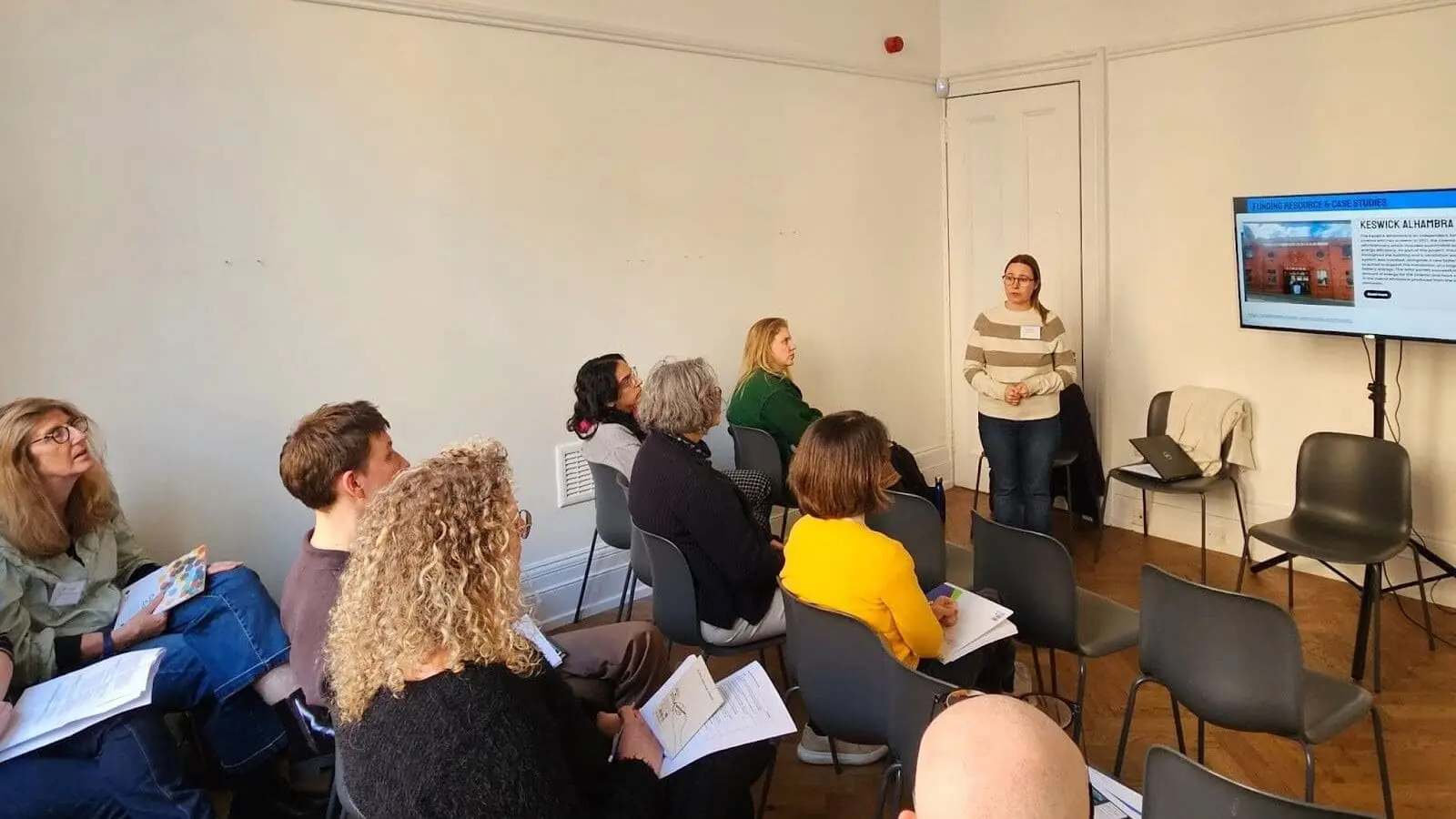
Danielle leading a workshop for Film Hub Scotland in Glasgow.
It has been fantastic to see organisations’ enthusiasm to keep learning and developing better environmental practice. We understand it can feel overwhelming to start measuring your impacts, and that environmental impact reporting shouldn’t come at the expense of actually taking action, but I have seen organisations manage both at the same time and find the journey to understanding and reducing their environmental impact really rewarding.
– Danielle, Programme Manager
We have worked with a range of organisations that have received BFI National Lottery funding over the last three years. This has included supporting them to report on environmental impacts, practice and progress via JB’s Creative Climate Tools through drop-in sessions, webinars, workshops, providing guidance on the Sustainable Screen Hub, and how-to videos. Our review of the data and information submitted has provided some useful insights:
- 88% have an environmental policy
- 77% have an action plan
- 67% use environmental data to inform decisions across operations and procurement
- Business travel made up 17% of organisations’ footprint on average
There is also a growing understanding that carbon emissions are only one piece of the environmental story, and aligning across production (how things are made), environmental programming (the stories we tell), and environmental good practice (how these stories are exhibited) is important. An impressive 74% of organisations have programmed work exploring environmental themes in the last year.
Some awardees are required to report on their environmental impacts for 2025-26: find out more here.
Claire’s highlight: engaging with young people

National Saturday Club participants (Photo: National Saturday Club)
One of my absolute highlights has been the opportunity to support the development of environmental thinking and action with organisations whose work with children and young people – through film as an educational tool and through skills development. I was particularly inspired by the care, concern and ideas shared with me by the young people on the National Saturday Club’s youth board.
– Claire Buckley, Programme Lead
There is growing recognition of the intersections between environmental sustainability, diversity, inclusion, justice and equity. Environmental action needs to work for everyone, in particular those least responsible and most impacted by the climate and nature crisis. It needs to be fair, inclusive and accessible.
We have seen initial progress with some organisations in joining the dots between environmental sustainability and equity, diversity and inclusion (EDI) – for example, the National Saturday Club’s work with its youth advisory board in shaping their environmental strategy. There is, however, still a long way to go, and climate justice will be a key area of focus for the 2026-29 programme.
Tenaya’s highlight: Climate RESILIENCE for screen archives & cinemas
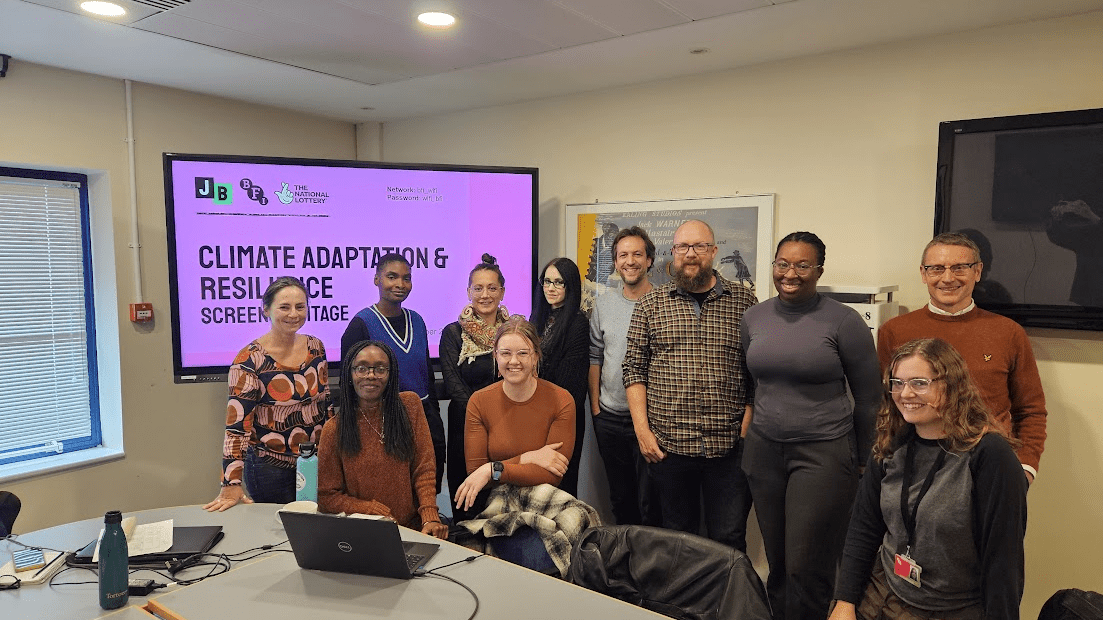
Adaptation and resilience workshop at the BFI Conservation Centre, for archives supported by the BFI National Lottery Screen Heritage Fund.
Preparing early for climate change can save money, resources, and even cultural buildings, records and objects. It was wonderful to work with screen archives and cinemas across the UK to help them understand the benefits of adaptation and building resilience in their communities.
– Tenaya, Climate Change & Sustainability Specialist
Over the three year programme, adaptation and place-based community resilience increasingly emerged as a key topic. Cinemas, archives and other screen venues see flooding, heat and more as an increasing risk, but can also be places of refuge (see, for example, the BFI’s Cool Off in Culture campaign).
JB worked with screen archives which were recipients of the BFI Screen Heritage Fund with one-on-one mentoring and in-person workshops – see reflections from the BFI National Archive and The Box, Plymouth. Considering local challenges, community demographics, and the unique power of cultural venues helped organisations understand how they could actively create their own resilient futures. This will be a focus for the 2026-2029 programme.
Keep up-to-date as the 2026-2029 programme starts
To find out more, explore the Sustainable Screen Hub, one of the largest collections of environmental resources and guidance for the screen sector beyond production, and sign up to JB’s newsletter.
See our impact in numbers for the 2023-2026 programme.
Spread the word