

“Where positive tipping points are succeeding, they’re rarely led by technocratic solutions but by cultural actors who believe in their collective agency.”
Who needs a climate week when you have the weather? This was the opening sentiment of every session, event and conversation at London Climate Action Week 2026 (LCAW) a few weeks ago. The heat stole the show – yet, despite the visceral reminder of our changing climate, the week also served as a beautiful reminder of how deeply nourishing it is to be in the company of friends and strong hearts.
It was a big week for JB, running three events that covered three major pillars of our work: climate justice, adaptation, and international climate policy.
- On climate justice, our Head of Programmes Taghrid Choucair-Vizoso hosted an inspiring session on culture’s role in a just transition beyond fossil fuels, which you can watch here.
- On adaptation, we launched the Cool Off for Culture campaign – a map of cultural spaces across the UK where people can cool down during heatwaves, along with our partners at BFI, Arts Council England and LIVE Green.
- On international climate policy, we co-hosted the Third International Seminar for Culture and Climate with the Brazilian Ministry of Culture, People’s Palace Projects, UCL Institute of Public Policy and Innovation, and Volans.
We’re still feeling the warmth of seeing so many old and new friends as we process the incredible insights shared by speakers across the week. Here’s a brief overview of what happened at the Third International Seminar for Culture and Climate.
Third International Seminar for Culture and Climate
The only annual global gathering of its kind and the association is significant: it tethers culture and climate together as political siblings.
The International Seminar of Culture and Climate was inaugurated in 2024 by Minister Menezes to accompany Brazil’s G20 presidency. The first seminar featured three Brazilian ministers, all women and all trail blazers – Minister Menezes for Culture, Marina Silva for the Environment, and Sônia Guajajara for Indigenous Peoples – alongside inspirational speakers and practitioners. The second seminar took place the following year in Rio, just before the Global Artivism Summit and COP30 in Belem. This year the seminar is taking place in two parts: the first at LCAW in Somerset House, and the second in Sao Paolo in August.
It’s no surprise that Brazil has taken the lead here. The country boasts two exceptional cultural icons as Culture Ministers, both appointed by President Lula: Gilberto Gil (2003–2008) and Margareth Menezes (2023-present). Both are musicians of extraordinary status, both from Bahia and both fully cognizant of the power, capacity and centrality of culture to tackling humanity’s greatest challenges. And Brazil, hosts of the most consequential COP since Paris, has not relented on leadership in the months since COP30. Instead, they are doubling down on their priorities, including an unwavering – and extremely welcome – support for culture.
We were joined for the LCAW installment of the third seminar by many colleagues and friends, including COP President Ambassador André Corrêa do Lago, who remarked that the humidity, foliage and joy of all beings present felt just like Belem. Alongside Marina Silva and his Presidency team, Ambassador André was the architect of the Global Mutirao and the Global Ethical Stocktake. In his first Presidency letter to the international community, he appealed directly to artists, philosophers and poets to help humanity move through grief and loss to action and implementation. This is exactly what this gathering set out to do.
Key insights
The event was split into two panels, each filled with insights on how to maintain the momentum that COP30 built for culture in climate action. Below we have pulled out some of the key ideas from each.
Of the opening remarks, from Carlos Paiva (Brazil Ministry of Culture), Thiago Jesus (People’s Palace Projects), Meriem Bouamrane (UNESCO) and His Excellency Antonio Patriota, Brazilian Ambassador to the United Kingdom:
- Culture as social infrastructure: Implementation is a well-worn phrase in climate discussions and this seminar was all about how culture can actually support and accelerate this. Yet, despite the potential of culture-based solutions, the sector remains chronically underfunded. Addressing this must be a top priority.
- Strengthening inclusion in national policies will be essential for more inclusive and locally grounded cultural responses. There must be more recognition of knowledge systems involving science and indigenous knowledge in international and national climate frameworks. Cultural actors can in turn support countries to better include culture into National Adaptation Plans (NAPs), Nationally Determined Contributions (NDCs) and Sustainable Development Goals (SDGs).
- Culture upstream of policy: We were reminded that before policy change, we must be able to imagine differently. Culture is the enabling factor upstream of policy to facilitate these new imaginaries. As the COP30 president put it: ‘The future is a practice of collection imagination that we carry out in the present’
To close the opening section, Thiago shared a powerful quote from Rebecca Solnitt:
Hope is not optimism. Optimism assumes the best, and assumes its inevitability, which leads to passivity, as do the pessimism and cynicism that assume the worst. Hope, like love, means taking risks and being vulnerable to the effects of loss. It means recognising the uncertainty of the future and making a commitment to try to participate in shaping.
Panel one – Governing for a Creative, Sustainable Transition: A Common Good approach
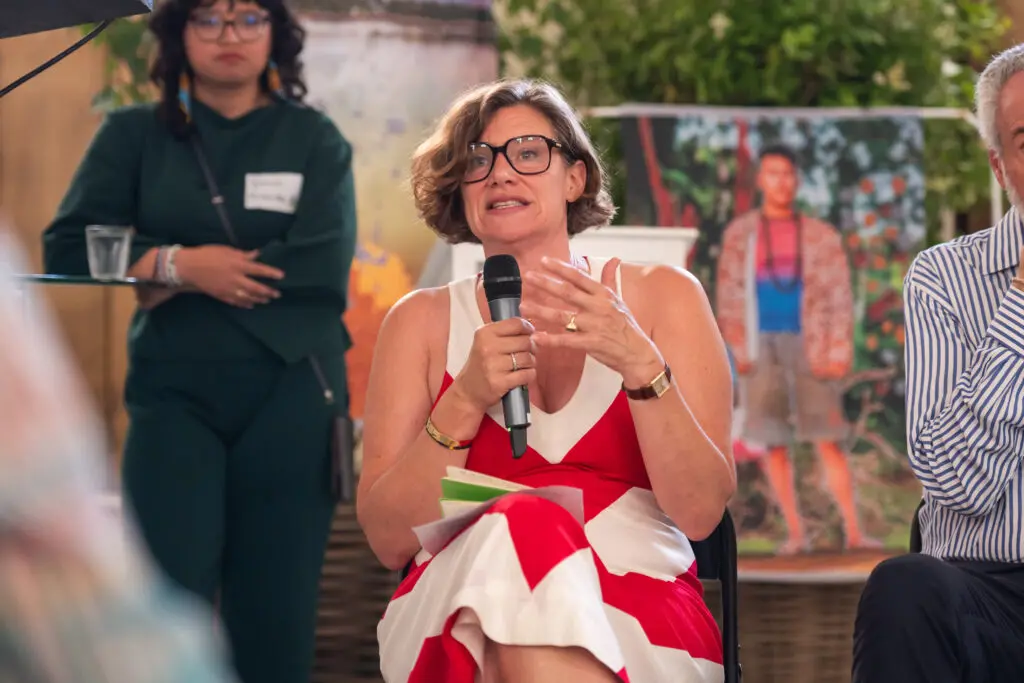
The first discussion, chaired by Maria Augusta Arruda, Director of Brazilian Biosciences National Laboratory, COP Presidency team, was an ambitious birds-eye take on climate and environmental solutions, with Ambassador André Corrêa do Lago, Marianna Mazzucato, and Tim Lenton, lead in Tipping Point science from Exeter University. Their combined insights made for a rich and gritty conversation.
- Cross-ministerial action on culture: How a government treats its Culture Minister and whether the appointment is viewed as a promotion or demotion, tells you a lot. In Brazil, the ecological transition is at the centre of government rather than being confined to the Environment Ministry, and this cross-ministerial approach has forced other departments, including Finance, to change too. Whilst this top-down direction is important, it can’t be the only solution: change must also come from the bottom up. Top-down governance can set the enabling conditions while leaving the how open for others to take forwards. Policies need to respond to lived experience on the ground so it requires true deliberation and co-governance to be designed into the system.
- Positive cultural tipping points: Change needs to happen quickly. Tim Lenton reflected on his research around planetary tipping points and the reality that we need to be tackling climate change 10 times faster to have a good chance of staying below 2C warming. The question on the table was how culture can support this kind of transformational shift. Norway’s transition to Electric Vehicles, for example, was largely driven by social activists; a useful reminder that where positive tipping points are succeeding, they’re rarely led by technocratic solutions but by cultural actors who believe in their collective agency.
- Bringing play into policymaking: Marianna Mazzucato delivered a powerful appeal for more play in policy making. Culture is based on play – trial and error – but play isn’t something that governments tend to legitimise, perhaps to the detriment of imagining new solutions. We were left with an important question about how culture can restore the practice of play in these contexts.
- A question of value: A key takeaway from the first session was also about our inability to value the long term benefits of culture. We must find better ways of understanding and articulating the incredible contribution that culture makes to all of our lives if we are to better support it.
Panel two: The Art of Creating Futures: Culture, Story and Collective Imagination
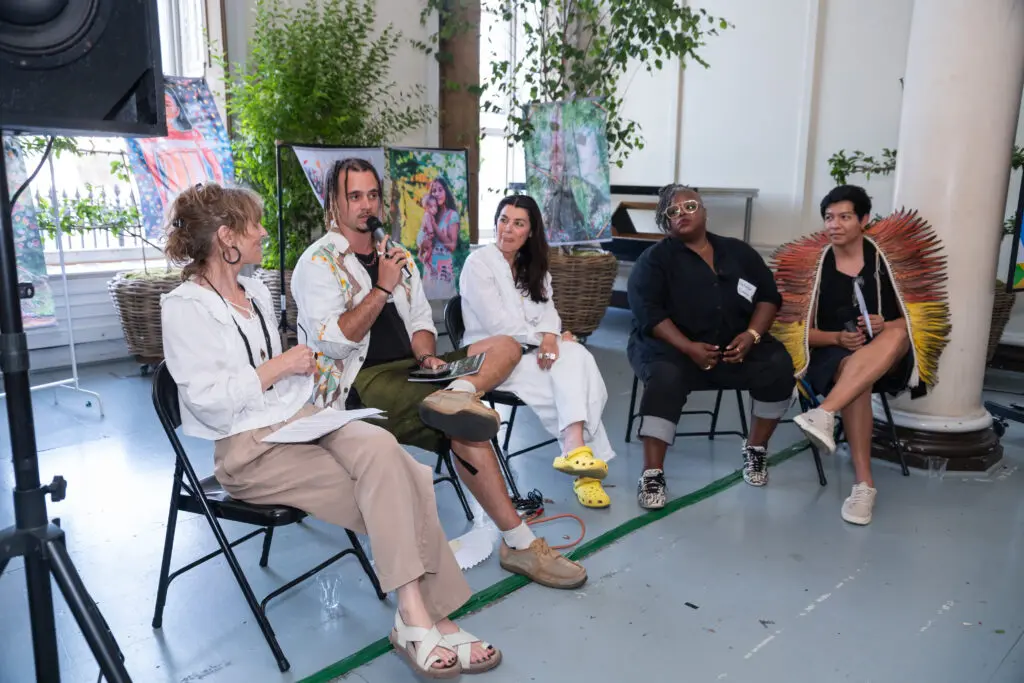
The second part was a conversation with artists – Louis VI, musician and zoologist, Es Devlin, award-winning artist and stage designer, Eric Terena, Indigenous artist and activist from the Pantanal, and Makeeba Browne, Vice President Justice & Equity at ClimateWorks, facilitated by Alison Tickell, JB’s Founder and Policy Director. Where the first panel worked on ideas, this one was embedded in practice, subverting the idea into culture and art as embodiment. One after another, the conversation centralised experience – of nature, cultural tradition and practice, of loss, joy and community.
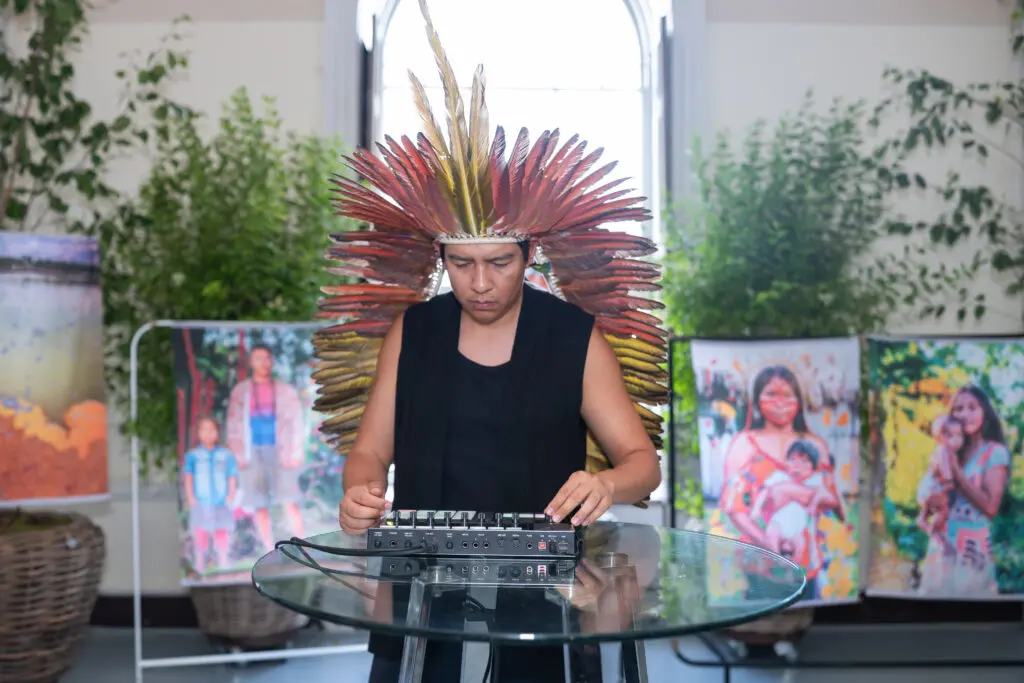
- Bridging the gap: Eric Terena reflected on his work as a DJ, building sets made up of sounds of the forest. Culture and technologies, he said, allows us to shorten the distance between people and ecosystems, allowing us to connect in new and meaningful ways. For him and his community, this is a matter of cultural survival as climate change is forcing his community to change how they sing and dress – a profound cultural loss not yet recognised in COP conversations around Loss & Damage. Ending with a message of hope, Eric reflected on his work cataloguing traditional songs before they’re lost to the next generation.
- We’re all imaginal cells: Es Devlin spoke on what preoccupies her: the process by which a caterpillar dissolves and reassembles as a butterfly by imaginal cells. She likened us all in this moment to imaginal cells and challenged us to think about what’s our compass for the transformation we need. She pointed to Timothy Morton’s call for artists to simply amaze people into changing their minds before ending with a powerful exercise about how we make habitats for the more-than-human within human imagination.
- Lost in translation: Makeeba Browne spoke on why equity needs to be our anchor and asked what it really means to open up the climate conversation. “I believe very firmly that we don’t have a knowledge gap but a translation one” she said, stating that we don’t translate what we know into jargon-free language that the communities we work with can use to shape their own stories. Who is creating the imagery and everyday language we’re all meant to be in conversation through?
- We need to start listening again: Louis VI closed the panel with the observation that we’ve stopped listening, like apples who have forgotten the tree they came from. He reminded us that we’re not the owners of culture – try telling a humpback whale that humans invented music – but just one of many cultural expressions amongst countless others, and that this diversity of narratives from living beings is essential. Louis reassured us that the solution to this disconnection doesn’t have to be hard, and that “we can get back to who we are if we start listening again”.
Culture is the essential social infrastructure we need to accelerate climate action. This event showed that through integrating cultural and Indigenous knowledge into climate policy, addressing the sector’s underfunding, and leveraging artistic practices, we can build the collective imagination required for meaningful system change.
Photo credits: Paolo Paparesta/Togada
Spread the word